Showing posts with label Neil deGrasse Tyson. Show all posts

Tuesday, March 18, 2014

Cosmos has arrived!


I first wrote about the re-make of Cosmos in this blog post. The first episode aired last Sunday evening. You can watch the first two episodes online, and I've also included the links below. 

In this first episode, Tyson introduces a few famous scientists from history and highlights how their ideas shaped the current model of the universe. What follows next is a whirlwind tour of the history of the universe--from the Big Bang all the way through to the evolution of man. 

Episode #2: Some of the Things That Molecules Do
In this episode, we leave the world of the stars and go to the molecular level--the genetic code. Tyson explains the difference between artificial and natural selection. Yet he cautions that even when evolution comes up with a specialized adaptation, there is no accounting for catastrophic events and the extinction of a species. The program concludes with speculation about life on other planets. 


This show is not meant to be a hard science program. The biology presented in the second episode is something that every high school student should know. Instead, I'm hoping this program will begin a dialogue. 

In this reboot of the Cosmos series, the producers' goals are to encourage science literacy. Executive producer Seth MacFarlane had this to say about the show:
"I think that there is a hunger for science and known about science 
and understanding of science that hasn't really been fed in the past 
two decades [...] There's been a real vacuum when it comes to science 
education. The nice thing about this show is that I think that it does what the 
original 'Cosmos' did and presents it in such a flashy, entertaining way that, as 
Carl Sagan put it in 1980, even people who have no interest in science 
will watch just because it's a spectacle."

I agree with MacFarlane's analysis--there has been a real lack of popular shows about the natural world. I'm not sure that the science presented on Cosmos needs to be flashy and entertaining. Yet I can appreciate the stories and animations as a way to introduce fundamental scientific discoveries and help foster an interest in those who wish to learn more. I hope that people who are interested in science will now have a starting point for further reading and researching topics of interest and that the show will inspire the public to support scientific research and discovery. 

Tuesday, September 3, 2013

Advice for your first-year of graduate education

As part of bootcamp, our program typically hosts a BBQ, where the first-years can meet older students, get advice regarding labs and classes, that sort of thing. And as one of the student directors of bootcamp this year, I was thinking about advice that I could offer--that I wish I might have known when entering grad school.

This post is a modified version of an email I sent to one of my friends congratulating her on her graduation from Macalester and offering advice for her first year of chemistry graduate school. Names and places have been removed for privacy, but the advice is largely the same. I've included some gifs and added comments where necessary to explain some of my thoughts. Some of the advice is meant to be humorous, but much of it is serious and potentially applicable to older students. 


1) Never be embarrassed to attend a seminar just for the free coffee/cookies/pizza/beer. 
You might discover a field or project you never even knew existed.


2) NOBODY uses Comic Sans on their posters or power points. 
Corollary: Nobody uses papyrus either.

3) Make sure you treat administrative staff with the utmost respect.
These people know all of the ins-and-outs of the system. They can make your time in grad school easier, or they can make it much more challenging. Your choice. 
Corollary: Make friends with the admin assistants that have candy.


4) Advice from my Labmates: Don't F*** s*** up. And when you do, make sure you're learned something.
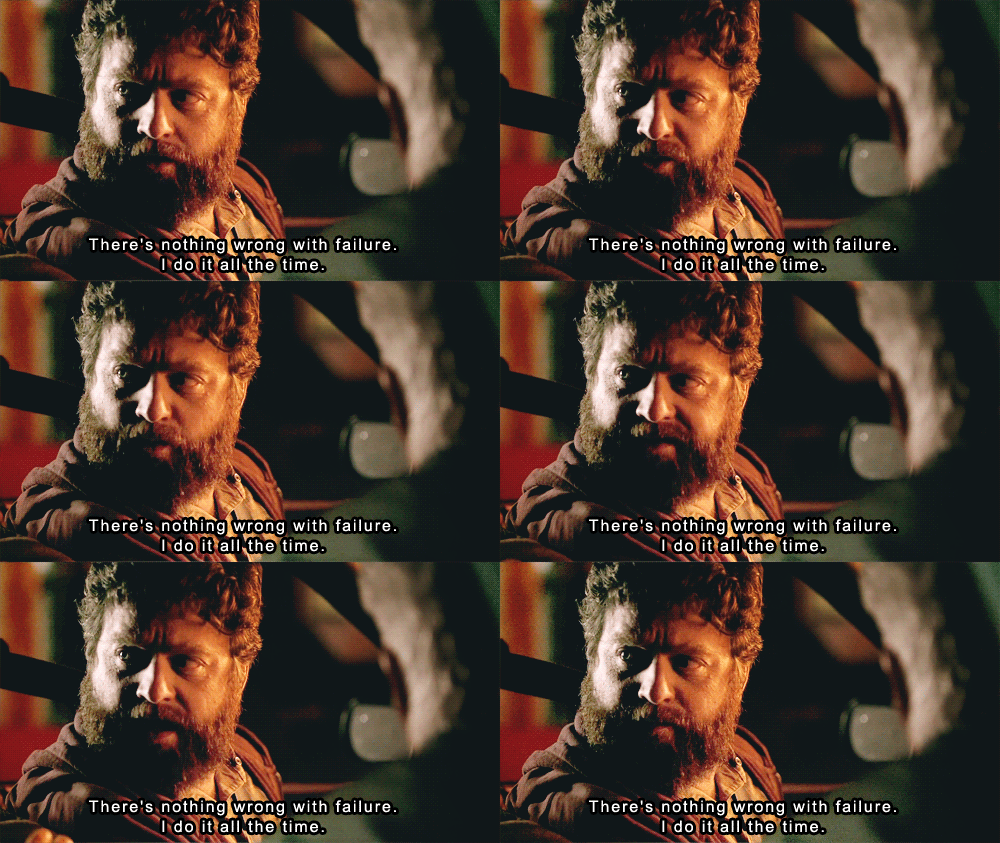
It's not a matter of if--trust me, you will screw up. One of the professors at UCSF gives the same speech to all the new students on the first day: "95% of what you do on a daily basis is fail. It's the 5%, it's when things work, that's when the magic happens!" 


5) Don't relate your self-worth to whether your experiment is successful or not.
See #4 above. To quote the biochemist Allan Wilson, "If everyone whose experiments failed stopped doing science, there wouldn't be any science."


6) Don't forget to enjoy your time there and laugh a bit. 
WhatShouldWeCallGradSchool
PhD Comics
The Hermitage

Corollary: Make sure you have outside hobbies/interests/friends beyond grad school.
We know you love your subject--or you wouldn't be here. But everyone needs a break now and again, no matter how awesome it is. Go surfing, go dancing, play soccer, play video games--whatever helps you clear your head. 


7) Remember to think about your mental/emotional health when joining a lab. 
A lab environment that works well for one student may not be work another student. If your program does lab rotations during the first year, pay attention while you are rotating. How do people get along in the lab? What kind of work-life balance is there? Some people like more social labs, while other just prefer to come and get their work done. What is the science like? Is this topic something you will enjoy for the next 4-6 years? How available would you like your advisor to be? Generally, younger professors will be more accessible, but might lack some of the funding of more established professors. Conversely, joining a well-established lab might mean that you rarely see your advisor, as they are often very busy. Ask advice from multiple people before you settle on a choice. Again, what works for some people might not work for others. 

Corollary: Pick the advisor, not the project. 


8) NEVER be afraid to ask for help.
You are a first-year. Nobody expects you to be an expert on the research and/or the methodology in a particular group. Ask professors, ask older students, ask postdocs, ask your classmates--chances are somebody at your university knows how to do what you need. 

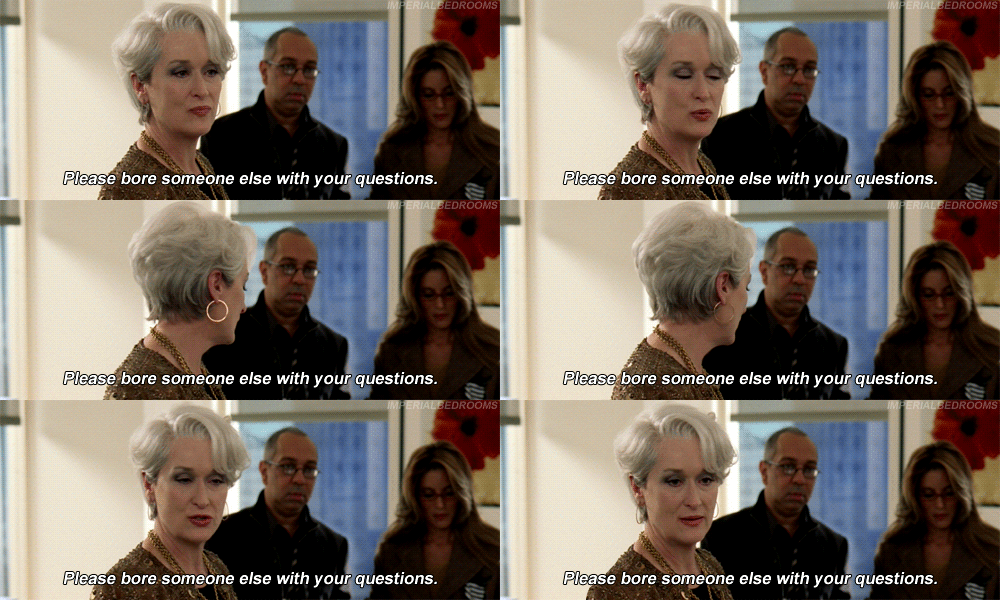
Corollary: There is no such thing as a stupid question when it comes to research. 
As Isaac Asimov said, "The most exciting phrase to hear in science, the one that heralds new discoveries, is not 'Eureak' but 'That's funny...'"

Corollary: If someone gives you papers to read, read them. Don't just skim the abstract and think you know what is happening. 

Corollary: Know WHO to ask for help.
Certain people are much better at giving advice or explaining experimental methods than others. You don't want this to happen:


9) Grad School is Hard
You will spend the first year feeling like an impostor, not really sure why you were let into the school in the first place. You are convinced that at any moment, they're going to find out exactly how little you know. This is normal--and trust me, you are not the only one in your class who feels like this. Many people in my class were convinced that they were "the dumb one" that somehow snuck into graduate school. They brought you there for a reason. If you feel stuck, just listen to Neil's advice:


10) Enjoy it!
Welcome to grad school! We all like to complain from time to time when experiments aren't working, but honestly, I still can't believe someone is giving me money to research a topic I love. So...have great conversations with classmates and leaders in the field, travel to conferences in different countries, experiment with new ideas, enjoy your flexible work schedule, eat good food at department functions....the list goes on!

Saturday, August 3, 2013

Cosmos - A Spacetime Odyssey

"A galaxy is composed of gas and dust and stars--billions upon billions of stars." 
                 --Carl Sagan, Cosmos, chapter 1, page 3.

Carl Sagan on the set of Cosmos

Cosmos: A Personal Voyage is a thirteen-part television series presented by the famous astrophysicist Carl Sagan. It originally aired in the fall of 1980, and covered a wide range of scientific topics including the Big Bang theory and the origin of life on earth, stars formation and star death, and the search for extraterrestrial life. The program was notable for its groundbreaking special effects and fantastic musical score. Cosmos was awarded both a Primetime Emmy and a Peabody award in 1981 (1). It has been broadcast in over 60 countries, translated into numerous languages, and remains one of the most widely watched PBS programs in the world (2). 

In August 2011, a remake of the show was announced. Scheduled to appear in the spring of 2014, it will be broadcast on both Fox and National Geographic. The show will be narrated by Neil deGrasse Tyson and Ann Druyan, Carl Sagan's widow, will be one of the executive producers. 

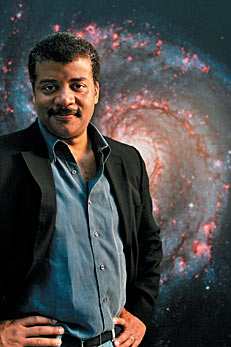
Astrophysicist and director of the Hayden Planetarium Neil deGrasse Tyson

Tyson and Druyan's new series will contain new material, as well as updated versions of topics from the original 1980 series. However, their goal is not simply to create a sequel, but rather a program that "issues forth from the times in which we are making it, so that it matters to those who is this emergent 21st century audience" (3).

In an interview with Big Picture Science, Tyson describes his hopes for the new series:

"The task for the next generation of Cosmos is a little bit different because 
I don't need to teach you textbook science. There's a lot of textbook science in 
the original Cosmos, but that's not what you remember the most. What most 
people who remember the original series remember most is the effort to 
present science in a way that has meaning to you that can influence your 
conduct as a citizen of the nation and of the world--especially of the world" (3).

I'm looking forward to the new series next spring. Not only are networks bringing science to Primetime, but if this show is anything like the original, I hope that it will fill people with wonder and awe as they recognize the tiny corner of the universe we inhabit...and how very much scientists still don't know. And with that, I'll leave you with the trailer (tell me this show will not be amazing!


References:
1) IMDb "Awards for Cosmos" http://www.imdb.com/title/tt0081846/awards. Accessed 3 Aug. 2013. 
2) Cosmo Learning Astronomy. http://www.cosmolearning.com/documentaries/cosmos/ Accessed 3 Aug. 2013. 
3) "Seth's Cabinet of Wonders" Big Picture Science.  http://radio.seti.org/blog/2012/03/big-picture-science-seths-cabinet-of-wonders/ Acessed 3 Aug. 2013.