
Showing posts with label pop. culture. Show all posts
Showing posts with label pop. culture. Show all posts
Friday, May 30, 2014

Tuesday, March 18, 2014
Cosmos has arrived!

I first wrote about the re-make of Cosmos in this blog post. The first episode aired last Sunday evening. You can watch the first two episodes online, and I've also included the links below.
In this first episode, Tyson introduces a few famous scientists from history and highlights how their ideas shaped the current model of the universe. What follows next is a whirlwind tour of the history of the universe--from the Big Bang all the way through to the evolution of man.
Episode #2: Some of the Things That Molecules Do
In this episode, we leave the world of the stars and go to the molecular level--the genetic code. Tyson explains the difference between artificial and natural selection. Yet he cautions that even when evolution comes up with a specialized adaptation, there is no accounting for catastrophic events and the extinction of a species. The program concludes with speculation about life on other planets.

This show is not meant to be a hard science program. The biology presented in the second episode is something that every high school student should know. Instead, I'm hoping this program will begin a dialogue.
In this reboot of the Cosmos series, the producers' goals are to encourage science literacy. Executive producer Seth MacFarlane had this to say about the show:
"I think that there is a hunger for science and known about science
and understanding of science that hasn't really been fed in the past
two decades [...] There's been a real vacuum when it comes to science
education. The nice thing about this show is that I think that it does what the
original 'Cosmos' did and presents it in such a flashy, entertaining way that, as
Carl Sagan put it in 1980, even people who have no interest in science
will watch just because it's a spectacle."
I agree with MacFarlane's analysis--there has been a real lack of popular shows about the natural world. I'm not sure that the science presented on Cosmos needs to be flashy and entertaining. Yet I can appreciate the stories and animations as a way to introduce fundamental scientific discoveries and help foster an interest in those who wish to learn more. I hope that people who are interested in science will now have a starting point for further reading and researching topics of interest and that the show will inspire the public to support scientific research and discovery.
Saturday, February 22, 2014
The Toast: Search for a Gal Scientist
For those of you who are up on the blogosphere, The Toast is searching for a female, PhD-level scientist to author a regularly occurring science column. As part of the search process, they have been running a series of one-off posts from female scientist contributors.
To read the full archive, follow this link or look for the tag 'gal science' on their website.
Physicist Kerstin Nordstrom is the author of the most recent Gal Science post. She addresses the frequently asked question 'So what is it you do?' and offers tips for interacting with scientists. If you have time, the entire post is a wonderful read. To paraphrase her advice, don't treat us like magical creatures, don't say things like "Oh, you must be really smart," and don't put us on the spot about our research topics unless you are genuinely interested in the answer.
And most importantly, do not compare me to Sheldon from The Big Bang Theory.

Sunday, January 26, 2014
Helix

Image from the "Pilot" episode courtesy of the Helix website.
Playing God and tampering with the genome can lead to deadly results--and that's clearly the case in the new original series "Helix" from the Syfy channel.
The series follows a group of experts from the Centers for Disease Control (CDC) who travel to a remote research compound in the Arctic to investigate a dangerous new disease outbreak. However what they soon discover is that this deadly virus changes and mutates infected individuals into something bestial and superhuman. Cut off from the rest of the world, the scientists face a terrifying life-and-death struggle to find a cure for the disease before an outbreak annihilates the human race.
Deception, double-agendas and constantly revealed plot twists make this show an exciting, fast-paced thriller. If you're interested, you can access the first three episodes here on the Syfy channel's website.
If you still have some doubts, the show boasts and impressive list of veteran producers including Steven Maeda from "The X-files," Stephen Welke from "Alphas," and Ron Moore who helped make the "Battlestar Galactica" remake into such an awesome series. After watching "Helix" the past few weeks, I have am certain that the rest of the season will be just as action-packed.
Saturday, October 26, 2013
Friday Funnies: Fail Edition
Friday Funnies: Fail edition!
1) That's not how you pipette
A collection of amusing movie and television scenes with some rather creative pipetting styles. My favorite is the guy trying to pipette without a tip.

2) Fail Lab
Scientists dissect the best of the 'epic fail' videos and reveal hidden lessons on science topics such as evolution, pyrotechnics, or electricity. Episode one is below.

1) That's not how you pipette
A collection of amusing movie and television scenes with some rather creative pipetting styles. My favorite is the guy trying to pipette without a tip.

2) Fail Lab
Scientists dissect the best of the 'epic fail' videos and reveal hidden lessons on science topics such as evolution, pyrotechnics, or electricity. Episode one is below.
The equivalent of PostSecret for scientists. The hashtag lets you report less-than-stellar lab practices that would never, under any circumstances, end up in a publication. Some are weird, some are scary, but almost all of them are amusing.

Friday, August 30, 2013
Friday Funnies
When I think I can explain my results...

...and then a new experiment crushes my theory.

Monday, August 5, 2013
Physics + Game of Thrones = WIN
Students from the Albert Einstein Institute created a handful of Game of Thrones inspired sigils (complete with house words). They pay tribute to some of the most exciting physics and astronomy projects.


Saturday, August 3, 2013
Cosmos - A Spacetime Odyssey
"A galaxy is composed of gas and dust and stars--billions upon billions of stars."
--Carl Sagan, Cosmos, chapter 1, page 3.

Carl Sagan on the set of Cosmos.
Cosmos: A Personal Voyage is a thirteen-part television series presented by the famous astrophysicist Carl Sagan. It originally aired in the fall of 1980, and covered a wide range of scientific topics including the Big Bang theory and the origin of life on earth, stars formation and star death, and the search for extraterrestrial life. The program was notable for its groundbreaking special effects and fantastic musical score. Cosmos was awarded both a Primetime Emmy and a Peabody award in 1981 (1). It has been broadcast in over 60 countries, translated into numerous languages, and remains one of the most widely watched PBS programs in the world (2).
In August 2011, a remake of the show was announced. Scheduled to appear in the spring of 2014, it will be broadcast on both Fox and National Geographic. The show will be narrated by Neil deGrasse Tyson and Ann Druyan, Carl Sagan's widow, will be one of the executive producers.
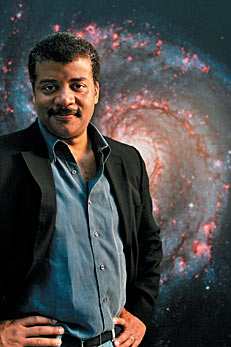
Astrophysicist and director of the Hayden Planetarium Neil deGrasse Tyson
Tyson and Druyan's new series will contain new material, as well as updated versions of topics from the original 1980 series. However, their goal is not simply to create a sequel, but rather a program that "issues forth from the times in which we are making it, so that it matters to those who is this emergent 21st century audience" (3).
In an interview with Big Picture Science, Tyson describes his hopes for the new series:
"The task for the next generation of Cosmos is a little bit different because
I don't need to teach you textbook science. There's a lot of textbook science in
the original Cosmos, but that's not what you remember the most. What most
people who remember the original series remember most is the effort to
present science in a way that has meaning to you that can influence your
conduct as a citizen of the nation and of the world--especially of the world" (3).
I'm looking forward to the new series next spring. Not only are networks bringing science to Primetime, but if this show is anything like the original, I hope that it will fill people with wonder and awe as they recognize the tiny corner of the universe we inhabit...and how very much scientists still don't know. And with that, I'll leave you with the trailer (tell me this show will not be amazing!)
References:
1) IMDb "Awards for Cosmos" http://www.imdb.com/title/tt0081846/awards. Accessed 3 Aug. 2013.
2) Cosmo Learning Astronomy. http://www.cosmolearning.com/documentaries/cosmos/ Accessed 3 Aug. 2013.
3) "Seth's Cabinet of Wonders" Big Picture Science. http://radio.seti.org/blog/2012/03/big-picture-science-seths-cabinet-of-wonders/ Acessed 3 Aug. 2013.
Subscribe to:
Posts (Atom)