Reason #836 why America needs to get-it-together regarding science education. Nobody wants their breakfast cereal to be an excellent source of Iridium* *Thanks to Izzy T. for the heads-up photography. Although most iridium compounds are insoluble, and therefore difficult for the body to absorb, finely divided iridium powder may ignite in the air.
Photo Credit: C.Fitzsimmons. Henry Coe State Park, CA
Spending time outside is a great way to unwind for many people. Research has shown that in addition to the physical benefits of participating in outdoor sports, there are also numerous psychological benefits, such as reduced stress, and increased ability to focus. But what about sleep?
Many people living in large, urban centers are exposed to artificial light. While nobody can deny the importance of artificial light in our society, these artificial lights can also impact the quality of sleep and disrupt internal circadian rhythms--which tell our bodies when to prepare for sleep and when to return to wakefulness. The ability to control our exposure to light has expanded the hours we work far beyond our natural internal clock. Yet exactly how much this clock has been effected was unknown.
A recent report in Current Biology (1) aimed to address just that. The report by Wright et al. compared the effects of a normal daily, electrical-light environment to a week of exposure to only natural lighting.
In the first part of the study, they measured the light exposure and internal circadian timing of 8 participants as they went about daily routines (including school/work, social activities, and self-selected sleep schedules.) This was measured with wrist monitors that recorded the intensity of the light, and the participants activity. Following the week of "typical" light exposure, the scientists took the volunteers on a week-long backpacking trip in the Colorado Rockies. The only light the group was exposed to during this time was natural lighting, namely sunlight, moonlight, and campfire light (no flashlights, no smart phones, etc).
When they compared the circadian rhythms between the electrical-lighting and natural-lighting stages of the experiment, they discovered a few interesting things. The participants were exposed to approximately 4 times more light on the backpacking trip as compared to the level of light exposure during their typical week. Their results also showed that the timing of the circadian clock shifted ~2 hours earlier although the total amount of time they slept remained about the same.
Wright and his team also looked at melatonin, a hormone that helps regulate our sleep-wake cycle. Melatonin rises before sleep and decreases throughout the night until after wake time. During the electric-light stage of the experiments, the participants melatonin levels were still high several hours after they awoke, indicating they were out of sync with the circadian clock. This melatonin paradox has been reported before and feelings of sleepiness or lower cognitive performance may be a consequence of spending time in electrically-lighted environments. However, after exposure to natural light, the melatonin offset shifted to approximately 50 min prior to wake time. This suggests that if circadian timing is aligned with the natural light-dark cycle in nature, the low point in brain arousal would move to before the end of the sleep cycle--making it easier to wake up in the morning.
This study is just the beginning, and Wright et al agree that they would like to conduct a follow-up study with subjects of different ages and different cultures, as well as those participants that may have sleep difficulties. In an article for the BBC (2), Wright spoke about the some of the results of the study and offered advice for applying these principles to everyday life: "Start your day off with a walk outside. At night reduce lights in the house, dim computer and electronic devices."
Obviously I would love to go camping every weekend, but most jobs rarely afford you the freedom to do that. In the meantime, I will settle for morning jogs along the bay and reading novels (*cough* I mean, scientific papers) before I go to sleep.
References:
1) Wright et al. "Entrainment of the Human Circadian Clock to the Natural Light-Dark Cycle." Current Biology2013, doi: 10.1016/j.cub.2013.06.039
Students from the Albert Einstein Institute created a handful of Game of Thrones inspired sigils (complete with house words). They pay tribute to some of the most exciting physics and astronomy projects.
"A galaxy is composed of gas and dust and stars--billions upon billions of stars."
--Carl Sagan, Cosmos, chapter 1, page 3.
Carl Sagan on the set of Cosmos.
Cosmos: A Personal Voyage is a thirteen-part television series presented by the famous astrophysicist Carl Sagan. It originally aired in the fall of 1980, and covered a wide range of scientific topics including the Big Bang theory and the origin of life on earth, stars formation and star death, and the search for extraterrestrial life. The program was notable for its groundbreaking special effects and fantastic musical score. Cosmos was awarded both a Primetime Emmy and a Peabody award in 1981 (1). It has been broadcast in over 60 countries, translated into numerous languages, and remains one of the most widely watched PBS programs in the world (2).
In August 2011, a remake of the show was announced. Scheduled to appear in the spring of 2014, it will be broadcast on both Fox and National Geographic. The show will be narrated by Neil deGrasse Tyson and Ann Druyan, Carl Sagan's widow, will be one of the executive producers.
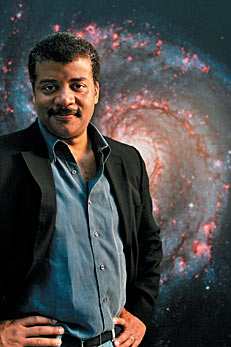
Astrophysicist and director of the Hayden Planetarium Neil deGrasse Tyson
Tyson and Druyan's new series will contain new material, as well as updated versions of topics from the original 1980 series. However, their goal is not simply to create a sequel, but rather a program that "issues forth from the times in which we are making it, so that it matters to those who is this emergent 21st century audience" (3).
In an interview with Big Picture Science, Tyson describes his hopes for the new series:
"The task for the next generation of Cosmos is a little bit different because
I don't need to teach you textbook science. There's a lot of textbook science in
the original Cosmos, but that's not what you remember the most. What most
people who remember the original series remember most is the effort to
present science in a way that has meaning to you that can influence your
conduct as a citizen of the nation and of the world--especially of the world" (3).
I'm looking forward to the new series next spring. Not only are networks bringing science to Primetime, but if this show is anything like the original, I hope that it will fill people with wonder and awe as they recognize the tiny corner of the universe we inhabit...and how very much scientists still don't know. And with that, I'll leave you with the trailer (tell me this show will not be amazing!)
References:
1) IMDb "Awards for Cosmos" http://www.imdb.com/title/tt0081846/awards. Accessed 3 Aug. 2013.
2) Cosmo Learning Astronomy. http://www.cosmolearning.com/documentaries/cosmos/ Accessed 3 Aug. 2013.
3) "Seth's Cabinet of Wonders" Big Picture Science. http://radio.seti.org/blog/2012/03/big-picture-science-seths-cabinet-of-wonders/ Acessed 3 Aug. 2013.
As an undergraduate, I was involved with Macalester's Women in Science and Math student organization. One of our goals was to create a network of both Macalester community members and science alumna to support women majoring in math and science. So when I received an email the other week about the NeXXT Program, sponsored by the New York Academy of Sciences, I was excited to learn about a new opportunity to be involved in academic mentoring for the next generation.
For the second year in a row, the US State Department, in collaboration with the New York Academy of Sciences, is sponsoring the NeXXT Scholars Program. This program aims to increase opportunities in STEM (Science, Technology, Engineering and Math) fields for women in both the US and countries with predominantly Muslim populations.
The Academy has paired with over 30 women's colleges in the United States to match incoming freshmen women pursuing a bachelors degree in a STEM academic field with an international counterpart. In addition to networking with each other and other NeXXT Scholars, both students are also paired individually with an established mentor in their field.
The mentor (a graduate student, postdoctoral scholar, or working professional) assists the scholar with career development, networking, and locating both research and skill building opportunities. Not only are the scholars able to serve as international ambassadors, but this program also helps them build skills they will need to become leaders in the respective fields.
I am writing all of this because the NeXXT community is currently looking for female STEM professionals (particularly graduate students and postdocs). If this is something that is interesting to you, I highly encourage you to apply. The link for the mentor application can be found here.
I chose to submit a mentor application for the NeXXT program, not only because I feel it's important to promote women in scientific fields, but also because I've had such positive experiences in a mentee role*. Speaking from personal experiences, this type of relationship is invaluable. Not only have my mentors provided feedback on things related to science (coaching powerpoint presentations, acting as a sounding board for unusual experimental results, reading drafts of proposals, etc.) but many of them have also given me fantastic life advice. The most recent individual who took time to mentor me grew up in a similarly sized hometown and (like me) went to a liberal arts institution before attending graduate school in the Bay Area. When asked, he was always genuinely happy to offer advice on any topic, and having someone with a similar background certainly made my transition into graduate school much easier. I hope in time that I can provide the same level of encouragement to the next generation.
*Though I was not involved in the NeXXT program as an undergraduate, I benefited from several fantastic mentors during the course of my bachelors degree.
My apologies for the diminished frequency of updates As was hinted by my previous post, I recently (and successfully) undertook the oral qualifying exam at my university. Needless to say, the process of writing the proposal and studying for the exam left very little time for other things last month.
I hope that I can now return to my usual updates of 2-3x per week. On the plus side, all of my studying has giving me some great ideas for new posts.
Hoping to have some new content out by the end of the week, until then, please enjoy the following article about the Art of Science.