
Showing posts with label outreach. Show all posts
Showing posts with label outreach. Show all posts
Friday, May 30, 2014

Thursday, March 6, 2014
Science Questions from Second Graders

The following is a partial list of the questions asked to me and my classmate today while teaching 2nd graders about the 5 senses:
- Do we get to try all the [5 senses] stations?
- Do you like candy? Do you like sour patch kids?
- Do you like lemonade?
- What is your favorite flavor of ice cream?
- Why are we eating paper? [When passing out the taste test strips]
- Are you poisoning us?!! [After eating the bitter-tasting PTC test strip]
- What's on your face? [Pointing to a handful of pimples on my forehead]
- Can you still taste if you are death [sic]? [I think this student meant 'deaf']
- How does hair grow?
- Why do stars glow?
- What is a shooting star?
- Does Pluto still exist?
- Do you have fun?
- Do you still live with your parents?
- Do you have a boyfriend?
- How old are you?
- Are you two [myself and my classmate] sisters?
- How do tornados get strong enough to throw houses and basketballs and stuff?
- Why do we get storms?
- When are you coming back?
Can't wait to see what they come up with for the next time I visit!
Tuesday, November 19, 2013

Thursday, November 7, 2013
Bay Area Science Festival Wrap-Up
The Bay Area Science Festival is a 10-day event organized by UCSF, UCSF's Science and Health Education Partnership, and a number of other co-sponsors. The main goal of the event is to bring science and science education to the public--though lectures, debates, workshops and a number of other activities throughout the Bay Area. This is the 3rd year the Festival is being held, and like the previous two years, I found time to volunteer at some of the interactive science booths on the "Discover Day" at AT&T Park.

Look at that awesome selfie where I shamelessly promote the Twin Cities
Last year I was involved with "Cabbage Juice Chemistry" booth. Essentially, using cabbbage juice as a handy pH indicator for various household items and asking children to predict if something was acidic or alkaline. This year, I was trained on the "Joint and Bone Models" booth. In our activity, we wanted to demonstrate the importance and complexity of our hands. To demonstrate this, we would slowly impair a child's ability to grasp and write by taping their fingers together with masking tape. The most drastic impairment, many children found, was the loss of their opposable thumb. After the exercise, many of them eagerly postulated why their thumb allowed them to do certain tasks that a pet cat or dog might not be able to accomplish.
I find that I don't think about the loss of my thumb very often. Yet after volunteering with this booth and seeing some of the models, I am becoming increasingly grateful for my opposable digit. Especially considering that many tasks I perform in the lab, such as pipetting, would be extremely difficult without my thumb. (Although, if the thatsnothowyoupipet Tumblr is any indication, I'm sure I could find a creative way to transfer liquids).
Aside from volunteering, I was also able to attend a few of the events myself. One of the last events of the festival takes place tomorrow evening. Astronaut Chris Hadfield is speaking at the NASA Ames Research Center in Mountain View, CA. For those of you who don't know Col. Hadfield, he did a cover of David Bowie's "Space Oddity" that received over 10 million views in the first few days it was posted (I've included it below for your viewing enjoyment).
Guess whose trivia team took first place and won tickets to the event?
Friday, October 11, 2013
The Culture of Women in Science: A Dialogue

I'm sure a number of people have read the NY Times article published last week on Women in the Sciences. If you haven't seen it, here is a link to the original article. Go ahead, I'll wait if you need to read it.
Now that everyone is on the same page, I want to take a few minutes to address some of the points it brings up about motivation and the culture of science. When I first saw this article posted, I was more than a bit skeptical. I was expecting another of the generic pieces that seem to appear once a year about women and minorities (or the lack thereof) in the sciences--pieces that mean well but never really advance the dialogue. There is certainly some of that in the article, but one of the things that stuck with me was this quote:
"As so many studies have demonstrated, success in math and the hard sciences, far from being a matter of gender, is almost entirely dependent on culture--a culture that teaches girls math isn't cool and no one will date them if they excel in physics; a culture in which professors rarely encourage their female students to continue on for advanced degrees; a culture in which success in graduate school is a matter of isolation, competition and ridiculously long hours in the lab; a culture in which female scientists are hired less frequently than men, earn less money and are allotted fewer resources."
GMP over at Academic Jungle had similar sentiments about a month ago:
"You constantly work against the background noise of "You don't belong here. You should not be doing this. This is no place for you." This is a tremendous overhead in terms of sheer energy, motivation, and perseverance that one has to put in just to get up in the morning to do the work. Trust me, women in male-dominated disciplines don't have the issue of lack of motivation; just the fact that they are there and haven't fled is a testament to their tenacity, which, if we could somehow measure it, we would find few men could rival. But much of it must continuously be used on fighting this negative background, which men really don't have to do. Men are not constantly communicated that they are constitutionally unable or unworthy to do their work, assumed incompetent until proven otherwise; for men, in contrast, competence is assumed."
This constant feedback, or as the article describes it, "all the little kicks that women get," can start to wear on you. And this feedback starts early:
As a 9 year old at summer camp, I signed up for a week-long activity where you learned about gears, wires, motors--this was all basic stuff, but at the end of the week everyone built a small battery-powered car. I was the only girl. Whenever I asked a question, the teacher would sigh or make a small quip about how "a woman's mind" worked. When my male peers asked nearly identical questions 5 minutes later, they were praised for their intuitive thinking. In 6th grade, a classmate and I placed into a math class with older students. When we arrived at the first class, the teacher greeted my classmate warmly and pointed him to an empty desk along the side of the room. The teacher then turned to me and asked, "Who are you? What are you doing here?" In high school, I was once accused of cheating on a science test because I performed basic algebra and unit conversions in my head. Never mind that the person I allegedly copied from received an 80%--I scored 98%.
How do we fight bias? How do we fight the idea that women are not as good as men in STEM disciplines? On an individual level, many women are part of the "ignore-the-naysayers-and-keep-at-it" school of thought. I will be the first to admit that I used this strategy in middle school and high school. Yet the drawback of ignoring naysayers is that it doesn't address the root of the problem--sexism is inherent in the structure of the system. Thus, we return to the age-old question:
There is little doubt in my mind that the structure of the field needs to change. It's not only about encouraging women to remain in research, but instead actively facilitating our stay. I've listed a few starting points for this structural overhaul. This is by no means an exhaustive list of ways that we can encourage women to remain in the sciences. Nor is this list intended as things that only women should be doing. In order to make progress--real change--the scientific community must come together to address these concerns.

Besides Marie Curie, how many historic women scientists can you name? What about current women in science fields? Who was the most recent woman to win a Nobel Prize for physics, chemistry or medicine? (Hint: no women in 2013). The sad fact is that we hear a great amount about the accomplishments of men. Female scientists often face discrimination or outright denial of their contributions; their work attributed to male scientists. Some notable examples from the 20th century include Rosalind Franklin (the structure of DNA) Lise Meitner (nuclear fission) and Marietta Blau (high energy particle physics). Don't forget to include the contributions of these and other women when teaching in your field. Their contributions are no less important to our understanding of nature.

When nominating or selecting people for awards, don't limit your field to only contributions by male scientists. Nobody wants to be the "token woman" and I'm not suggesting a quota system. But we need more awards to be distributed like the MacArthur "Genius" awards (11 of the 24 awards went to women this year), instead of like the Society for Industrial and Applied Mathematics Fellows (2 of the 33 Fellows). I need to believe that women are doing cutting-edge research that is just as interesting as their male counterparts...if only someone would allow them into the spotlight.
Acknowledgements:
Special thanks to Naomi Y. and Louise G. for their helpful discussions and editing prowess.
References:
1) Eileen Pollack, "Why are there still so few women in science?"The New York Times. Published Online 3 Oct. 2013.
2) GMP "What Impostor Syndrome is About." Academic Jungle. Web. 25 Aug. 2013.
3) FemaleScienceProfessor "She Would Not Wish This on Her Nieces." FemaleScienceProfessor. Web. 1 Oct. 2013.
4) Moss-Racusin et al. "Scientific faculty's subtle gender biases favor male students." Proc. Natl. Acad. Sci. USA. 2012. 109(41) 16474.
5) xkcd "How It Works." http://xkcd.com/385/
6) Academic Men Explain Things to Me. Tumblr. http://mainsplained.tumblr.com/
7) Abigail Golden. "MacArthur's Genius Women: A look at the 11 female innovators recognized this year." Women in the World. Web. 1 Oct. 2013.
8) Suggestions of ways to be a mentor:
"You constantly work against the background noise of "You don't belong here. You should not be doing this. This is no place for you." This is a tremendous overhead in terms of sheer energy, motivation, and perseverance that one has to put in just to get up in the morning to do the work. Trust me, women in male-dominated disciplines don't have the issue of lack of motivation; just the fact that they are there and haven't fled is a testament to their tenacity, which, if we could somehow measure it, we would find few men could rival. But much of it must continuously be used on fighting this negative background, which men really don't have to do. Men are not constantly communicated that they are constitutionally unable or unworthy to do their work, assumed incompetent until proven otherwise; for men, in contrast, competence is assumed."
This constant feedback, or as the article describes it, "all the little kicks that women get," can start to wear on you. And this feedback starts early:
As a 9 year old at summer camp, I signed up for a week-long activity where you learned about gears, wires, motors--this was all basic stuff, but at the end of the week everyone built a small battery-powered car. I was the only girl. Whenever I asked a question, the teacher would sigh or make a small quip about how "a woman's mind" worked. When my male peers asked nearly identical questions 5 minutes later, they were praised for their intuitive thinking. In 6th grade, a classmate and I placed into a math class with older students. When we arrived at the first class, the teacher greeted my classmate warmly and pointed him to an empty desk along the side of the room. The teacher then turned to me and asked, "Who are you? What are you doing here?" In high school, I was once accused of cheating on a science test because I performed basic algebra and unit conversions in my head. Never mind that the person I allegedly copied from received an 80%--I scored 98%.
How do we fight bias? How do we fight the idea that women are not as good as men in STEM disciplines? On an individual level, many women are part of the "ignore-the-naysayers-and-keep-at-it" school of thought. I will be the first to admit that I used this strategy in middle school and high school. Yet the drawback of ignoring naysayers is that it doesn't address the root of the problem--sexism is inherent in the structure of the system. Thus, we return to the age-old question:
How do we get more girls/women to stick with science?
1) Call people out on their behavior
This is perhaps the most important point and why I've chosen to list it first. Both men and women (yes, we are not immune) can show biases against women in the sciences. Don't believe me? There was a study by Moss-Racusin et al. published in PNAS last September whereby science faculty from research universities rated application materials of a student for a lab manager position. Despite identical resume qualifications (and a randomly assigned male or female name for the student) faculty participants rated the male applicants as "more hire-able" than the female applicants and offered the fictional 'John' a greater starting salary. Both male and female faculty members did this. To start making changes, we need to address personal and departmental biases.
A) Start with your own behavior and biases:
Don't assume incompetence until proven otherwise. Don't assume women at scientific conferences are just "along for the ride." Don't assume a women is dumb if she asks a question in class or a seminar. Don't generalize if someone makes a mistake (See the xckd below):
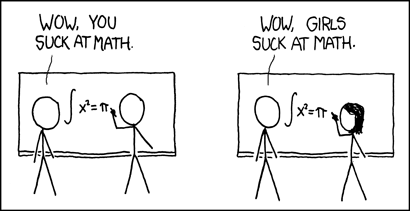
B) Recognize the biases of others: All of the statements in the paragraph above also apply here. In short never assume anything. Draw attention to these people. My personal favorite: Academic Men Explain Things to Me. This website deals with an all too common problem in STEM fields: mansplaining. Recognizing bias is only the first half of the battle. If you do encounter mansplaining, discrimination or sexism, how should you respond? 1) Cite Facts: Women earned over 50% of the bachelors degrees in chemistry last year. 2) Question their position: What makes you say that? Do you think that's really the case? In some instances, the discriminators are just repeating something another person said. When asked to stop and really confront the position, they may change their tune. If not, refer back to point #1 and cite facts. 3) Respond directly: I don't think about women that way. OR Would you have said [statement] if I was male? OR I take offense at [statement]. That was sexist. Tell people why their comments were sexist. Ask for what you want and don't want to be said. Will some people react poorly to being confronted directly? Yes, but when others are unwilling to honor requests about how we prefer to be treated, it is not our problem for speaking out, their behavior is the real problem.
2) Promote women scientistsBesides Marie Curie, how many historic women scientists can you name? What about current women in science fields? Who was the most recent woman to win a Nobel Prize for physics, chemistry or medicine? (Hint: no women in 2013). The sad fact is that we hear a great amount about the accomplishments of men. Female scientists often face discrimination or outright denial of their contributions; their work attributed to male scientists. Some notable examples from the 20th century include Rosalind Franklin (the structure of DNA) Lise Meitner (nuclear fission) and Marietta Blau (high energy particle physics). Don't forget to include the contributions of these and other women when teaching in your field. Their contributions are no less important to our understanding of nature.

Rosalind Franklin
When nominating or selecting people for awards, don't limit your field to only contributions by male scientists. Nobody wants to be the "token woman" and I'm not suggesting a quota system. But we need more awards to be distributed like the MacArthur "Genius" awards (11 of the 24 awards went to women this year), instead of like the Society for Industrial and Applied Mathematics Fellows (2 of the 33 Fellows). I need to believe that women are doing cutting-edge research that is just as interesting as their male counterparts...if only someone would allow them into the spotlight.
3) Mentor in whatever capacity you are able to do so.
As an undergraduate, I was involved in Macalester's Women in Science and Math student organization. I was able to see first-hand the impact mentor/mentee relationships had on encouraging women to remain in STEM fields. Again, this is not intended to be something that only women can do. Women shouldn't have an obligation to mentor every single female student in a department. While women might be in a position to share unique perspective about being female scientists, I speak from personal experience when I say that some of the best advice I have ever received has been from male professors. Every little bit of time helps. Whatever capacity you wish to mentor--be it taking a student for the summer or offering to read someones application essays--all it takes to be a mentor is a willingness to contribute positively (8). This relates directly back to issues of culture and feedback. Mentoring shows women that someone is encouraging them, that someone "has their back," someone feels that they are not only allowed to be here with the guys, but that they deserve to be here.
Will it be challenging to change the face of science? Yes. Is it a worthy fight? Yes! Women are in academia to stay. So rather than trying to maintain the "old boys club" isn't it about time we change the paradigm that women shouldn't be in science?Acknowledgements:
Special thanks to Naomi Y. and Louise G. for their helpful discussions and editing prowess.
References:
1) Eileen Pollack, "Why are there still so few women in science?"The New York Times. Published Online 3 Oct. 2013.
2) GMP "What Impostor Syndrome is About." Academic Jungle. Web. 25 Aug. 2013.
3) FemaleScienceProfessor "She Would Not Wish This on Her Nieces." FemaleScienceProfessor. Web. 1 Oct. 2013.
4) Moss-Racusin et al. "Scientific faculty's subtle gender biases favor male students." Proc. Natl. Acad. Sci. USA. 2012. 109(41) 16474.
5) xkcd "How It Works." http://xkcd.com/385/
6) Academic Men Explain Things to Me. Tumblr. http://mainsplained.tumblr.com/
7) Abigail Golden. "MacArthur's Genius Women: A look at the 11 female innovators recognized this year." Women in the World. Web. 1 Oct. 2013.
8) Suggestions of ways to be a mentor:
a) The NeXXT Scholars Program, which I wrote about in a previous post, is always looking for women to mentor.
b) Volunteer at a local elementary/middle school as a tutor.
c) Invite a high school or undergraduate student into your lab to do summer research.
d) Offer to read college/grad school applications. Or when the time comes, offer to read drafts of scientific manuscripts.
e) Take younger students out for ice cream or coffee, and let them ask questions about your life
f)...and many more! There are hundreds of ways to mentor someone.
b) Volunteer at a local elementary/middle school as a tutor.
c) Invite a high school or undergraduate student into your lab to do summer research.
d) Offer to read college/grad school applications. Or when the time comes, offer to read drafts of scientific manuscripts.
e) Take younger students out for ice cream or coffee, and let them ask questions about your life
f)...and many more! There are hundreds of ways to mentor someone.
Saturday, September 21, 2013
Paleontologist Kristi Curry Rogers
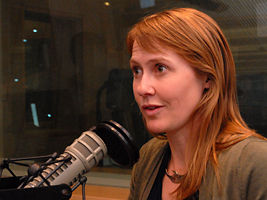
Kristi Curry Rogers, Associate Professor at Macalester College,
speaking on MPR in 2011 (Photo Credit: Tim Nelson)
Listen to Curry Rogers segment from Minnesota Public Radio as she discusses her on-going fossil research in Montana. (Originally aired 9-19-2013).
Try this link if the above audio doesn't work.
Wednesday, July 3, 2013
NeXXT Scholars Program
As an undergraduate, I was involved with Macalester's Women in Science and Math student organization. One of our goals was to create a network of both Macalester community members and science alumna to support women majoring in math and science. So when I received an email the other week about the NeXXT Program, sponsored by the New York Academy of Sciences, I was excited to learn about a new opportunity to be involved in academic mentoring for the next generation.
For the second year in a row, the US State Department, in collaboration with the New York Academy of Sciences, is sponsoring the NeXXT Scholars Program. This program aims to increase opportunities in STEM (Science, Technology, Engineering and Math) fields for women in both the US and countries with predominantly Muslim populations.
The Academy has paired with over 30 women's colleges in the United States to match incoming freshmen women pursuing a bachelors degree in a STEM academic field with an international counterpart. In addition to networking with each other and other NeXXT Scholars, both students are also paired individually with an established mentor in their field.
The mentor (a graduate student, postdoctoral scholar, or working professional) assists the scholar with career development, networking, and locating both research and skill building opportunities. Not only are the scholars able to serve as international ambassadors, but this program also helps them build skills they will need to become leaders in the respective fields.
I am writing all of this because the NeXXT community is currently looking for female STEM professionals (particularly graduate students and postdocs). If this is something that is interesting to you, I highly encourage you to apply. The link for the mentor application can be found here.
I chose to submit a mentor application for the NeXXT program, not only because I feel it's important to promote women in scientific fields, but also because I've had such positive experiences in a mentee role*. Speaking from personal experiences, this type of relationship is invaluable. Not only have my mentors provided feedback on things related to science (coaching powerpoint presentations, acting as a sounding board for unusual experimental results, reading drafts of proposals, etc.) but many of them have also given me fantastic life advice. The most recent individual who took time to mentor me grew up in a similarly sized hometown and (like me) went to a liberal arts institution before attending graduate school in the Bay Area. When asked, he was always genuinely happy to offer advice on any topic, and having someone with a similar background certainly made my transition into graduate school much easier. I hope in time that I can provide the same level of encouragement to the next generation.
*Though I was not involved in the NeXXT program as an undergraduate, I benefited from several fantastic mentors during the course of my bachelors degree.
Monday, April 15, 2013
Volunteering with SEP
One of the things that I'm really excited about is teaching. Teaching is something I did throughout high school and college, both as a tutor and a more formal Teaching Assistant. I really enjoy that "Aha!" moment, when a student has been struggling with a particular concept for a long time, and it finally clicks with them. The other thing that I am really passionate about is science outreach. There have been a number of studies exploring the reasons why people shy away from science, or why the reasons why certain groups are underrepresented in various fields. I'm not going to get into this topic too much in this post, sufficient to say that I think early exposure to science is critical. And what better way to combine early exposure to science and teaching that through volunteering in public schools!
UCSF has a program called "Science and Health Education Partnership" (SEP). The basic idea behind the program is to pair students/postdocs with a teacher in the San Francisco Unified School District. The scientist-teacher team then plans and executes a series of lessons throughout the semester. Sometime programs last a few months and the scientists teach just 4-6 lessons, whereas other programs last the entire school year.
So far I've been involved in two semester-long programs during my time at UCSF. As a first-year grad student, I was involved in the Bio&ChemTeach program. I was paired with a 7th grade Life Science classroom, along with two other students from my graduate program. The school where we taught was ranked in the bottom 5% of schools in California, and served mostly students of Latino decent. Our lessons were designed to fit into their existing curriculum--and thus didn't really follow a theme or share continuity with each other.
One of my favorite lessons from last spring was entitled "A Day in the Life." We asked the students to describe various characteristics shared by scientists. We kept a list of their ideas on the chalkboard. As would be expected, the students came up with many popular stereotypes: geeky, no friends, pale from working all day in the lab, evil geniuses, (and my personal favorite) "tall socks and crazy hair!" We quickly broke down some of these stereotypes with help from this Tumblr: This is What A Scientist Looks Like. The students were still a bit incredulous, as many of them had never considered that scientists were anything other than white males.
We had also put together a slide show of "A Day in the Life." I literally took a camera to work and documented my day down to the minute. Some of the slides were serious--photographs of me preparing a reaction in a round-bottom flask, or pipetting compounds into a 96 well plate. Some of the photos were silly--giving bunny ears to an unsuspecting lab tech or pretending to sword fight with paper towel tubes after lunch. Mostly we tried to show activities like attending seminar with classmates, performing an experiment, or eating lunch with my friends--all of the types of things they do in school. At the end of the slide show, we also had some photos from activities I enjoy outside of the lab: hiking in the Grand Tetons; playing rugby; swing dancing. My partner and I also took the time to emphasize that neither one of us got "the best" grades in science classes--but that we stuck with it because it was something we enjoyed.
For many of the students, this slide show and our admission of average grades was a revelation. The discussion we had at the end of our lesson was rowdy! They talked excitedly about different types of science fields, frequently interrupting each other to ask my partner or I questions about our hobbies or the classes we took in high school to prepare to study science. More importantly in my book, they no longer saw science as an unattainable career path pursued only by socially-awkward white men.
This spring, I am involved in SEP's STAT program, which stands for "Scientist-Teacher Action Teams." I was paired with a 4th-grade classroom along with another student who is in UCSF's Neuroscience grad program. I will save the details of our lessons for another time because this post is already too long. But needless to say, I am excited to be back in the classroom and excited to expose elementary schoolers to the joys of science.
Getting Involved in the Bay Area:
1) UCSF Science and Health Education Partnership
2) Bay Area Science Festival
3) UCB Lawrence Hall of Science
4) Community Resources for Science
Getting Involved in the Bay Area:
1) UCSF Science and Health Education Partnership
2) Bay Area Science Festival
3) UCB Lawrence Hall of Science
4) Community Resources for Science
Subscribe to:
Posts (Atom)