Friday, April 25, 2014

Friday Fun: Elementary School Edition

"What do owls eat?"

This past Thursday was my last SEP science lesson for this school year. Building from our digestion theme from the last visit, this lesson was all about owl pellets. Owls frequently swallow their prey whole. However, they cannot digest the prey's fur or bones, so they regurgitate the material. 

Scientists often collect the owl pellets and study their contents to determine seasonal eating habits and estimate populations of various rodent species. Owl pellets are also a common first dissection for elementary school children, as the bones are well-preserved, it feels like a treasure hunt for the kids, and they can learn fantastic scientific method skills like asking questions (What do owls eat?), testing their hypotheses (performing the dissection), analyzing the results (What did we find in the owl pellets? How many of each rodent are there?) and drawing conclusions. 

The children were incredibly excited to do the owl pellet dissection--constantly calling one of us over to show what they had found or to ponder what a particular bone was used for. It was a whirlwind end to the semester, but everyone (including the teachers) seemed to really enjoy it.

After both classes were finished, the teachers presented us each with a bouquet of flowers

Flowers! 

and a packet of really cute thank-you letters. 


This student drew a picture of the preserved small intestine we brought. 


Fun and cute excerpts from our thank-you letters:
1) Dear Mr. Louise (sic) and Ms. Christina...
2) I liked to touch the guts but the guts stinked (sic).
3) It was cool when you put germs on our hands. 
4) I remember when you had five senses.
5) Thank you for visiting our class room and teaching us cool science stuff? (sic)

This was my third year in a row volunteering with SEP. I also think this was my favorite year. The teachers we partnered with were absolutely amazing! The students were always so well-prepared before we came in and always asked insightful questions. Their preparation and the students genuine enthusiasm made it really easy to get them thinking aloud and participating in the experiments. 

As Henri Poincaré, the French mathematician wrote:

"The scientist does not study nature because it is useful; he studies it because
he delights in it, and he delights in it because it is beautiful." 

I hope Louise and I had a positive influence on the students and that some of them choose to stick with science. It's a field with many ups and downs, but it's also so full of wonder and awe. 


Sunday, April 6, 2014

microFutures

Each week, Nature publishes a science fiction story in their "Futures" column. At the beginning of the year, they challenged readers to write a science fiction story in no more than 200 characters. Here is the winning entry, as well as some of my favorite submissions.

WINNER:
I pass your empty chair every day. Across the room sits the computer, your voice, your face locked inside. I ache to bring you to life, but fear keeps me in my chair. What if you say no?
--Catherine Rastovsk


Favorites:
off that switch, Professor! Your time machine can't travel back in time past the moment of its own creation and instead will trap the Universe in an endlessly recursive time-like loop! Take your hands
--Judith Reeves-Stevens

We gather, receiving the voice of a deserted explorer. "I have found the lunar colony," she says across the void. "Their logs simply state, 'We die alone'." Eyes downcast, we hear the broadcast end.
--Alasdair MacLeod

As robots perform the laboratory work, it is cheaper just to electronically stimulate the areas of the student's brain associated with frustration and failure, and then, after 3 years, call them doctor.
--Gavin Garland


To see the full list, visit: http://www.nature.com/nature/journal/v508/n7494/full/508144a.html

Monday, March 31, 2014

Dr. Cynthia Wolberger

Dr. Cynthia Wolberger of Johns Hopkins is giving a seminar on Tuesday (April 1st) as part of the Mission Bay Lecture Series here at UCSF. She will present recent work from her lab on how ubiquitination affects transcription. Typically, the speaker also gives an informal lunch talk with students the day before the main event. This one sounds interesting:


Friday, March 28, 2014

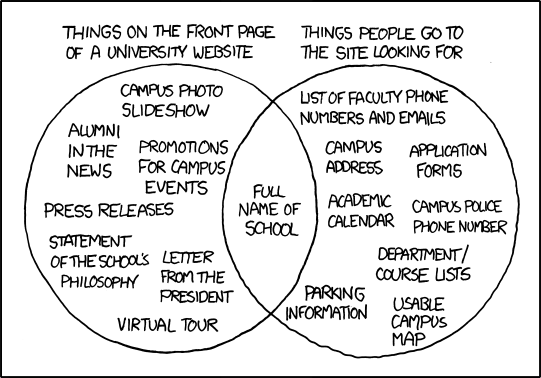
Friday Funnies: Venn Diagram Edition

1) Nerds vs. Geeks (credit--Yamamoto Lab, UCSF)


2) University Websites (credit-xkcd)


3) Mathematics meets Rap (credit-SMBC)


4) Explaining my life (credit-f*** no grad school)


Happy Friday!


Tuesday, March 18, 2014

Cosmos has arrived!


I first wrote about the re-make of Cosmos in this blog post. The first episode aired last Sunday evening. You can watch the first two episodes online, and I've also included the links below. 

In this first episode, Tyson introduces a few famous scientists from history and highlights how their ideas shaped the current model of the universe. What follows next is a whirlwind tour of the history of the universe--from the Big Bang all the way through to the evolution of man. 

Episode #2: Some of the Things That Molecules Do
In this episode, we leave the world of the stars and go to the molecular level--the genetic code. Tyson explains the difference between artificial and natural selection. Yet he cautions that even when evolution comes up with a specialized adaptation, there is no accounting for catastrophic events and the extinction of a species. The program concludes with speculation about life on other planets. 


This show is not meant to be a hard science program. The biology presented in the second episode is something that every high school student should know. Instead, I'm hoping this program will begin a dialogue. 

In this reboot of the Cosmos series, the producers' goals are to encourage science literacy. Executive producer Seth MacFarlane had this to say about the show:
"I think that there is a hunger for science and known about science 
and understanding of science that hasn't really been fed in the past 
two decades [...] There's been a real vacuum when it comes to science 
education. The nice thing about this show is that I think that it does what the 
original 'Cosmos' did and presents it in such a flashy, entertaining way that, as 
Carl Sagan put it in 1980, even people who have no interest in science 
will watch just because it's a spectacle."

I agree with MacFarlane's analysis--there has been a real lack of popular shows about the natural world. I'm not sure that the science presented on Cosmos needs to be flashy and entertaining. Yet I can appreciate the stories and animations as a way to introduce fundamental scientific discoveries and help foster an interest in those who wish to learn more. I hope that people who are interested in science will now have a starting point for further reading and researching topics of interest and that the show will inspire the public to support scientific research and discovery.