Saturday, September 28, 2013

Saturday, September 21, 2013

Paleontologist Kristi Curry Rogers

Kristi Curry Rogers, Associate Professor at Macalester College,
speaking on MPR in 2011 (Photo Credit: Tim Nelson)


Listen to Curry Rogers segment from Minnesota Public Radio as she discusses her on-going fossil research in Montana. (Originally aired 9-19-2013).


Try this link if the above audio doesn't work.

Tuesday, September 3, 2013

Advice for your first-year of graduate education

As part of bootcamp, our program typically hosts a BBQ, where the first-years can meet older students, get advice regarding labs and classes, that sort of thing. And as one of the student directors of bootcamp this year, I was thinking about advice that I could offer--that I wish I might have known when entering grad school.

This post is a modified version of an email I sent to one of my friends congratulating her on her graduation from Macalester and offering advice for her first year of chemistry graduate school. Names and places have been removed for privacy, but the advice is largely the same. I've included some gifs and added comments where necessary to explain some of my thoughts. Some of the advice is meant to be humorous, but much of it is serious and potentially applicable to older students. 


1) Never be embarrassed to attend a seminar just for the free coffee/cookies/pizza/beer. 
You might discover a field or project you never even knew existed.


2) NOBODY uses Comic Sans on their posters or power points. 
Corollary: Nobody uses papyrus either.

3) Make sure you treat administrative staff with the utmost respect.
These people know all of the ins-and-outs of the system. They can make your time in grad school easier, or they can make it much more challenging. Your choice. 
Corollary: Make friends with the admin assistants that have candy.


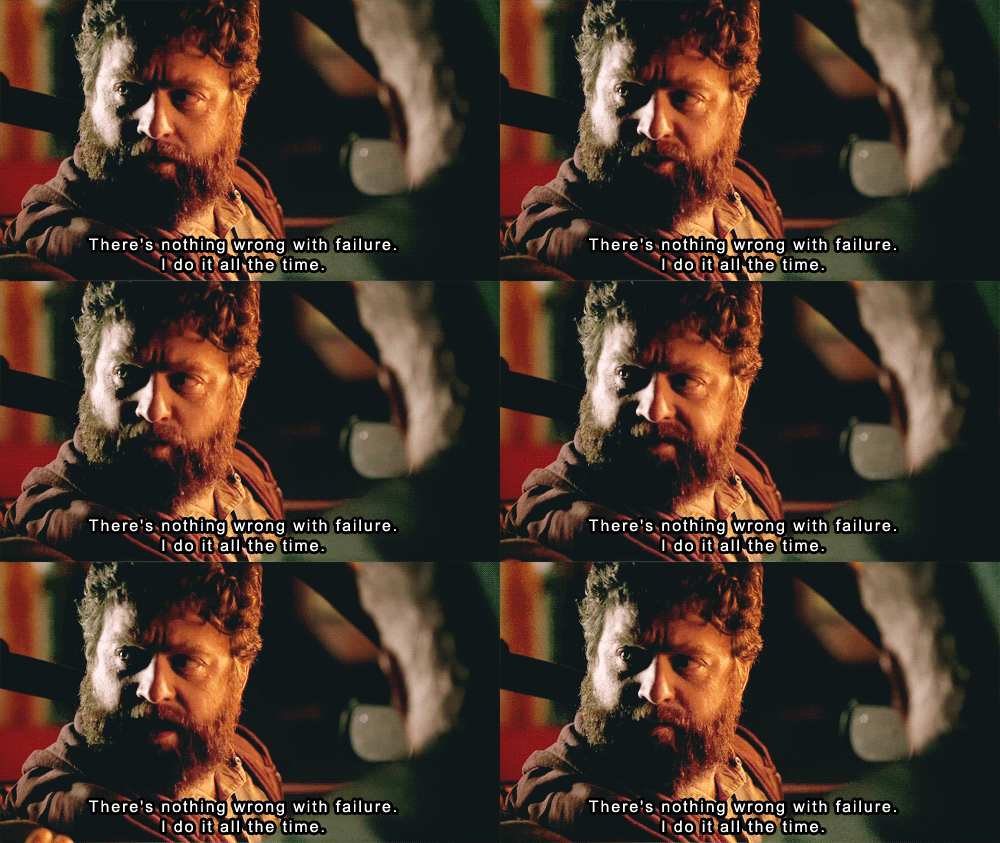
4) Advice from my Labmates: Don't F*** s*** up. And when you do, make sure you're learned something.
It's not a matter of if--trust me, you will screw up. One of the professors at UCSF gives the same speech to all the new students on the first day: "95% of what you do on a daily basis is fail. It's the 5%, it's when things work, that's when the magic happens!" 


5) Don't relate your self-worth to whether your experiment is successful or not.
See #4 above. To quote the biochemist Allan Wilson, "If everyone whose experiments failed stopped doing science, there wouldn't be any science."


6) Don't forget to enjoy your time there and laugh a bit. 
WhatShouldWeCallGradSchool
PhD Comics
The Hermitage

Corollary: Make sure you have outside hobbies/interests/friends beyond grad school.
We know you love your subject--or you wouldn't be here. But everyone needs a break now and again, no matter how awesome it is. Go surfing, go dancing, play soccer, play video games--whatever helps you clear your head. 


7) Remember to think about your mental/emotional health when joining a lab. 
A lab environment that works well for one student may not be work another student. If your program does lab rotations during the first year, pay attention while you are rotating. How do people get along in the lab? What kind of work-life balance is there? Some people like more social labs, while other just prefer to come and get their work done. What is the science like? Is this topic something you will enjoy for the next 4-6 years? How available would you like your advisor to be? Generally, younger professors will be more accessible, but might lack some of the funding of more established professors. Conversely, joining a well-established lab might mean that you rarely see your advisor, as they are often very busy. Ask advice from multiple people before you settle on a choice. Again, what works for some people might not work for others. 

Corollary: Pick the advisor, not the project. 


8) NEVER be afraid to ask for help.
You are a first-year. Nobody expects you to be an expert on the research and/or the methodology in a particular group. Ask professors, ask older students, ask postdocs, ask your classmates--chances are somebody at your university knows how to do what you need. 

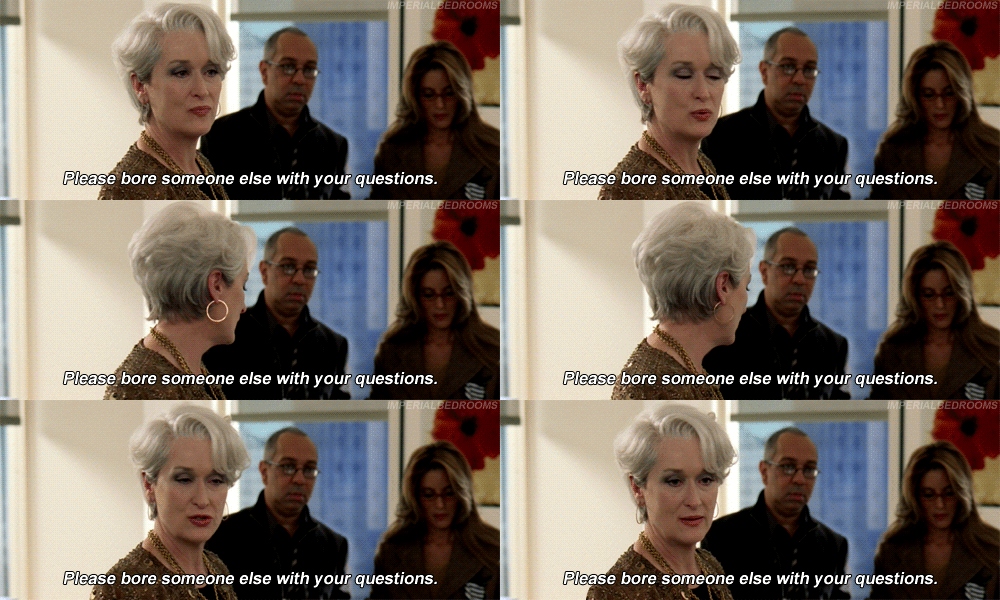
Corollary: There is no such thing as a stupid question when it comes to research. 
As Isaac Asimov said, "The most exciting phrase to hear in science, the one that heralds new discoveries, is not 'Eureak' but 'That's funny...'"

Corollary: If someone gives you papers to read, read them. Don't just skim the abstract and think you know what is happening. 

Corollary: Know WHO to ask for help.
Certain people are much better at giving advice or explaining experimental methods than others. You don't want this to happen:


9) Grad School is Hard
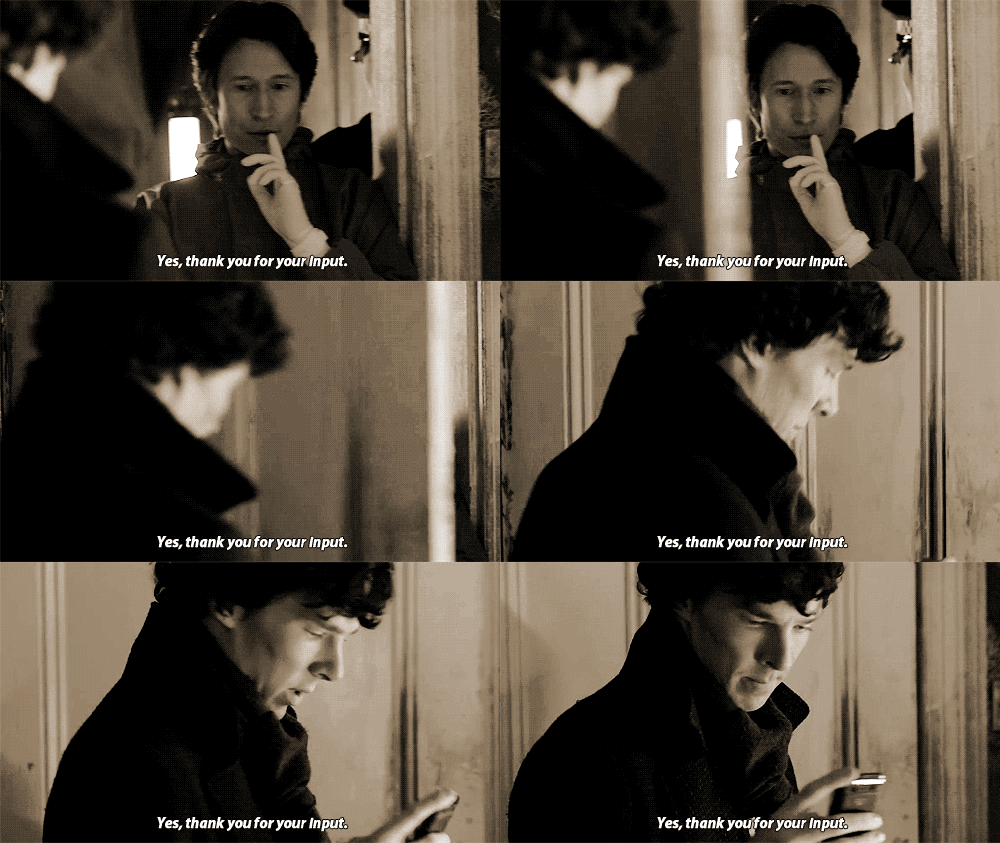
You will spend the first year feeling like an impostor, not really sure why you were let into the school in the first place. You are convinced that at any moment, they're going to find out exactly how little you know. This is normal--and trust me, you are not the only one in your class who feels like this. Many people in my class were convinced that they were "the dumb one" that somehow snuck into graduate school. They brought you there for a reason. If you feel stuck, just listen to Neil's advice:


10) Enjoy it!
Welcome to grad school! We all like to complain from time to time when experiments aren't working, but honestly, I still can't believe someone is giving me money to research a topic I love. So...have great conversations with classmates and leaders in the field, travel to conferences in different countries, experiment with new ideas, enjoy your flexible work schedule, eat good food at department functions....the list goes on!
Friday, August 30, 2013

Friday Funnies

When I think I can explain my results...

...and then a new experiment crushes my theory.


Thursday, August 22, 2013

Science Education Fail


Reason #836 why America needs to get-it-together regarding science education.  Nobody wants their breakfast cereal to be an excellent source of Iridium*


*Thanks to Izzy T. for the heads-up photography. 
Although most iridium compounds are insoluble, and therefore difficult for the body to absorb, finely divided iridium powder may ignite in the air. 

Tuesday, August 13, 2013

Tired? Stressed? The Cure is Camping!

Photo Credit: C.Fitzsimmons. Henry Coe State Park, CA

Spending time outside is a great way to unwind for many people. Research has shown that in addition to the physical benefits of participating in outdoor sports, there are also numerous psychological benefits, such as reduced stress, and increased ability to focus. But what about sleep?

Many people living in large, urban centers are exposed to artificial light. While nobody can deny the importance of artificial light in our society, these artificial lights can also impact the quality of sleep and disrupt internal circadian rhythms--which tell our bodies when to prepare for sleep and when to return to wakefulness. The ability to control our exposure to light has expanded the hours we work far beyond our natural internal clock. Yet exactly how much this clock has been effected was unknown. 

A recent report in Current Biology (1) aimed to address just that. The report by Wright et al. compared the effects of a normal daily, electrical-light environment to a week of exposure to only natural lighting.
In the first part of the study, they measured the light exposure and internal circadian timing of 8 participants as they went about daily routines (including school/work, social activities, and self-selected sleep schedules.) This was measured with wrist monitors that recorded the intensity of the light, and the participants activity. Following the week of "typical" light exposure, the scientists took the volunteers on a week-long backpacking trip in the Colorado Rockies.  The only light the group was exposed to during this time was natural lighting, namely sunlight, moonlight, and campfire light (no flashlights, no smart phones, etc). 

When they compared the circadian rhythms between the electrical-lighting and natural-lighting stages of the experiment, they discovered a few interesting things. The participants were exposed to approximately 4 times more light on the backpacking trip as compared to the level of light exposure during their typical week. Their results also showed that the timing of the circadian clock shifted ~2 hours earlier although the total amount of time they slept remained about the same. 

Wright and his team also looked at melatonin, a hormone that helps regulate our sleep-wake cycle. Melatonin rises before sleep and decreases throughout the night until after wake time. During the electric-light stage of the experiments, the participants melatonin levels were still high several hours after they awoke, indicating they were out of sync with the circadian clock. This melatonin paradox has been reported before and feelings of sleepiness or lower cognitive performance may be a consequence of spending time in electrically-lighted environments. However, after exposure to natural light, the melatonin offset shifted to approximately 50 min prior to wake time. This suggests that if circadian timing is aligned with the natural light-dark cycle in nature, the low point in brain arousal would move to before the end of the sleep cycle--making it easier to wake up in the morning. 

This study is just the beginning, and Wright et al agree that they would like to conduct a follow-up study with subjects of different ages and different cultures, as well as those participants that may have sleep difficulties. In an article for the BBC (2), Wright spoke about the some of the results of the study and offered advice for applying these principles to everyday life: "Start your day off with a walk outside. At night reduce lights in the house, dim computer and electronic devices."

Obviously I would love to go camping every weekend, but most jobs rarely afford you the freedom to do that.  In the meantime, I will settle for morning jogs along the bay and reading novels (*cough* I mean, scientific papers) before I go to sleep.


References:
1) Wright et al. "Entrainment of the Human Circadian Clock to the Natural Light-Dark Cycle." Current Biology 2013,  doi: 10.1016/j.cub.2013.06.039

2) McGrath, Matt. "Carry on Camping--Can a week under canvas reset our body clocks?" BBC News Science and Environment. http://www.bbc.co.uk/news/science-environment-23530408. (Accessed 8 August 2013). 


Monday, August 5, 2013

Physics + Game of Thrones = WIN

Students from the Albert Einstein Institute created a handful of Game of Thrones inspired sigils (complete with house words). They pay tribute to some of the most exciting physics and astronomy projects.