Showing posts with label Award. Show all posts

Wednesday, October 8, 2014

The 2014 Nobel Prize in Chemistry

The Royal Swedish Academy of Sciences has decided to award the Nobel Prize in Chemistry for 2014 to Eric Betzig, Stefan W. Hell and William E. Moerner for the development of super-resolved fluorescence microscopy."


Eric Betzig                                    Stefan Hell                                 William Moerner


Optical microscopy was limited for a long time by the presumed limitation that it would never get resolution better than half the wavelength of light. In what is now known as 'nanoscopy' this year's Nobel Laureates circumvented this limitation, with the help of fluorescent molecules. Their pioneering work in the field of microscopy allows us to see how molecules create synapses between nerve cells, track proteins involved in Alzheimer's and Parkinson's disease, and follow individual proteins as a fertilized egg divides into an embryo. 


Watch the announcement here:

Tuesday, October 7, 2014

The 2014 Nobel Prize in Physics

The Royal Swedish Academy of Sciences has decided to award the Nobel Prize in Physics for 2014 to Isamu Akasaki, Hiroshi Amano, and Shuji Nakamura, for the invention of efficient blue light-emitting diodes which has enabled bright and energy-saving white light sources."


This year's Nobel Laureates invented a new energy efficient light source--the blue light-emitting diode (LED). With the invention of blue LEDs, white light can be created in new ways that is both longer lasting and more efficient than older alternative light sources.

Listen to Shuji Nakamura's reaction:


Watch the announcement of the prize and learn more about LEDs here!

Monday, October 6, 2014

The 2014 Nobel Prize in Physiology or Medicine

The Nobel Assembly at Karolinska Institutet has today decided to award the 2014 Nobel Prize in Physiology or Medicine with one half to John O'Keefe, and the other half jointly to May-Britt Moser and Edvard I. Moser for their discoveries of cells that constitute a positioning system in the brain. 


John O’Keefe
Studying rats in 1971, O'Keefe discovered that certain nerve cells in the hippocampus of the brain were activated when the rat was at a particular place in the environment. At other places, different nerve cells were active. He proposed the brain has "place cells" which allow rats to build an inner map of the environment.

May Britt and Edvard I. Moser
The Moser's work focused on a nearby structure in the brain, the entohinal cortex. They found that nerve cells in this portion of the brain were activated when rats passed certain locations in a maze. Together, these locations formed a hexagonal grid, with each "grid cell" as they called them, reacting in a unique spatial pattern. The grid cells form a coordinate system that allows for spatial navigation.

Grid cells and place cells form networks with each other and also with other cells that recognize the direction of the rat's head. This complex network is an inner GPS for the brain. However it's not just rats that have this positioning system. Humans, too, appear to have similar cells as those found in the rat brains.

Listen to their reactions:

May-Brit Moser:


John O'Keefe:


Edvard I. Moser:


Relevant Publications:
1. O'Keefe and Dostrovsky. "The hippocampus as a spatial map. Preliminary evidence from unit activity in the freely-moving rat brain." Brain Research, 1971, 34, 171.

2. O'Keefe, J. "Place units in the hippocampus of the freely moving rat." Experimental Neurology, 1976, 34, 78.

3. Fyhn et al. "Spatial representation in the entohinal cortex." Science, 2004, 305, 1258.

4. Hafting, et al. "Microstructure of spatial map in the entohinal cortex." Nature, 2005, 436, 801.

5. Sargolini et al. "Conjunctive representation of position, direction, and velocity in the entohinal cortex." Science, 2008, 312, 758.

Sunday, October 5, 2014

Nobel Week


The Nobel Prize is a set of awards in the fields of literature, medicine, physics, chemistry, economics and peace. It is awarded annually in recognition of cultural and/or scientific advances and is widely considered the most prestigious award in the above fields. 

For scientists, the Nobel Prize is like winning a gold medal at the Olympics or "Best Actor" at the Oscars. It's a really, really big deal. 

So in honor of Nobel Week, I will be highlighting all of the 2014 prizes. The first announcement, scheduled for Oct 6th, is in the field of Physiology or Medicine. Predictions anyone? 


Read more about the Nobel Foundation here

Sunday, September 21, 2014

In the News: A link roundup


1) Dr. Kristi Curry Rogers, a biologist and geologist at Macalester College, shares her thoughts on evolution and it's role in the world today. 


2) Dr. Michael Fischbach, a chemist at UCSF, talks to the NYT about the research his lab is conducting on the microbiome, as well as the results of a study his group recently published in the journal Cell

Link to the NY Times article
Link to the study published in the journal Cell


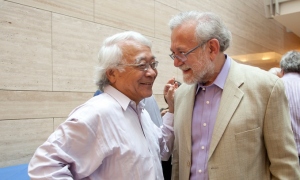
Peter Walter, PhD (right) speaks with UCSF's vice-chancellor of Research Keith Yamamoto, PhD

3) Dr. Peter Walter (above right), a biochemist at UCSF, is the recipient of the 2014 Lasker Basic Medical Research Award. Dr. Walter is sharing this award with Kazutoshi Mori, PhD, a researcher at Kyoto University. 

The two scientists are being honored for their work on the Unfolded Protein Response or UPR, a cellular quality-control system which is believed to play a role in certain neurodegenerative diseases, diabetes, and cancer. This is Walter's second major award of the year--he and Mori also shared the Shaw Prize in May. 


Tuesday, January 7, 2014

Forbes 30 under 30

Congratulations to UCSF student Jon Ostrem (left) and UCSF fellow David Weinberg (right) for being named to Forbes 30 under 30 list in the field of Science!


Ostrem, a student in the lab of Kevan Shokat, created mutant-specific inhibitors of the oncogene K-Ras.
Weinberg, a fellow at UCSF,  is studying how cells determine how much protein to produce.

I expect we will continue to hear many awesome things from these two! For the full list, follow This Link.