Where are the women at the International Math Olympiad competition? Fivethirtyeight looks at the distribution of women on these teams.
http://fivethirtyeight.com/datalab/girls-are-rare-at-the-international-math-olympiad/
Showing posts with label STEM. Show all posts
Showing posts with label STEM. Show all posts
Thursday, July 23, 2015

Wednesday, October 8, 2014
The 2014 Nobel Prize in Chemistry
The Royal Swedish Academy of Sciences has decided to award the Nobel Prize in Chemistry for 2014 to Eric Betzig, Stefan W. Hell and William E. Moerner for the development of super-resolved fluorescence microscopy."


Eric Betzig Stefan Hell William Moerner
Optical microscopy was limited for a long time by the presumed limitation that it would never get resolution better than half the wavelength of light. In what is now known as 'nanoscopy' this year's Nobel Laureates circumvented this limitation, with the help of fluorescent molecules. Their pioneering work in the field of microscopy allows us to see how molecules create synapses between nerve cells, track proteins involved in Alzheimer's and Parkinson's disease, and follow individual proteins as a fertilized egg divides into an embryo.
Watch the announcement here:
Tuesday, October 7, 2014
The 2014 Nobel Prize in Physics
The Royal Swedish Academy of Sciences has decided to award the Nobel Prize in Physics for 2014 to Isamu Akasaki, Hiroshi Amano, and Shuji Nakamura, for the invention of efficient blue light-emitting diodes which has enabled bright and energy-saving white light sources."
This year's Nobel Laureates invented a new energy efficient light source--the blue light-emitting diode (LED). With the invention of blue LEDs, white light can be created in new ways that is both longer lasting and more efficient than older alternative light sources.
Listen to Shuji Nakamura's reaction:
Watch the announcement of the prize and learn more about LEDs here!
Monday, October 6, 2014
The 2014 Nobel Prize in Physiology or Medicine
The Nobel Assembly at Karolinska Institutet has today decided to award the 2014 Nobel Prize in Physiology or Medicine with one half to John O'Keefe, and the other half jointly to May-Britt Moser and Edvard I. Moser for their discoveries of cells that constitute a positioning system in the brain.


John O’Keefe
Studying rats in 1971, O'Keefe discovered that certain nerve cells in the hippocampus of the brain were activated when the rat was at a particular place in the environment. At other places, different nerve cells were active. He proposed the brain has "place cells" which allow rats to build an inner map of the environment.
May Britt and Edvard I. Moser
The Moser's work focused on a nearby structure in the brain, the entohinal cortex. They found that nerve cells in this portion of the brain were activated when rats passed certain locations in a maze. Together, these locations formed a hexagonal grid, with each "grid cell" as they called them, reacting in a unique spatial pattern. The grid cells form a coordinate system that allows for spatial navigation.
Grid cells and place cells form networks with each other and also with other cells that recognize the direction of the rat's head. This complex network is an inner GPS for the brain. However it's not just rats that have this positioning system. Humans, too, appear to have similar cells as those found in the rat brains.
Listen to their reactions:
May-Brit Moser:
John O'Keefe:
Edvard I. Moser:
Relevant Publications:
1. O'Keefe and Dostrovsky. "The hippocampus as a spatial map. Preliminary evidence from unit activity in the freely-moving rat brain." Brain Research, 1971, 34, 171.
2. O'Keefe, J. "Place units in the hippocampus of the freely moving rat." Experimental Neurology, 1976, 34, 78.
3. Fyhn et al. "Spatial representation in the entohinal cortex." Science, 2004, 305, 1258.
4. Hafting, et al. "Microstructure of spatial map in the entohinal cortex." Nature, 2005, 436, 801.
5. Sargolini et al. "Conjunctive representation of position, direction, and velocity in the entohinal cortex." Science, 2008, 312, 758.
Sunday, October 5, 2014
Nobel Week

The Nobel Prize is a set of awards in the fields of literature, medicine, physics, chemistry, economics and peace. It is awarded annually in recognition of cultural and/or scientific advances and is widely considered the most prestigious award in the above fields.
For scientists, the Nobel Prize is like winning a gold medal at the Olympics or "Best Actor" at the Oscars. It's a really, really big deal.
So in honor of Nobel Week, I will be highlighting all of the 2014 prizes. The first announcement, scheduled for Oct 6th, is in the field of Physiology or Medicine. Predictions anyone?
Read more about the Nobel Foundation here
Wednesday, March 12, 2014
Betabrand's Smart Fashion
I'm not usually one to write about clothing or pay much attention to fashion (1). But I will make an exception to discuss San Francisco-based Betabrand. Back in January, Betabrand sent out an open casting call for a photoshoot that would highlight their spring clothing collection. The call specified the company wanted women with advanced degrees or who were working towards advanced degrees.
Over 60 women Ph.D.s and doctoral candidates responded to the call, including my own classmate, Nicole.

If you have time, visit Betabrand's website and check out the collection. Even if the clothing is not your style, I think we can all agree that these women are rockstars.
1) In fact, I tend to wear my clothing until it is literally falling apart.
2) Disclaimer: I am in no way being paid to endorse Betabrand.
Thursday, February 20, 2014
SEP Volunteering: Year 3

I've written about UCSF's Science-Education Partnership (SEP) program previously. Since arriving at UCSF in 2011, I've been involved with two semester-long programs. My first year I was involved with the Bio&Chem Teach program, where I was partnered with a 7th grade life-science classroom. Last year I participated in the STAT program and was placed with a 4th grade classroom.
This is my third year volunteering with SEP. After some scheduling difficulties, my classmate and I were placed in a pair of 2nd grade classrooms. Although both teachers are new to the SEP program, they brought a lot of great ideas to our first planning meeting and I am incredibly excited to be working with their students.
Our first visit to the classroom to meet the students was last week. Both classrooms had great questions for us and were excited to hear we were coming back four more times over the course of the semester. We've planned a series of lessons progressing from good/bad bacteria to human intestines, with lots of interesting experiments along the way. Hopefully by the end of the school-year I can convince some of them to stick with science!
Friday, October 11, 2013
The Culture of Women in Science: A Dialogue

I'm sure a number of people have read the NY Times article published last week on Women in the Sciences. If you haven't seen it, here is a link to the original article. Go ahead, I'll wait if you need to read it.
Now that everyone is on the same page, I want to take a few minutes to address some of the points it brings up about motivation and the culture of science. When I first saw this article posted, I was more than a bit skeptical. I was expecting another of the generic pieces that seem to appear once a year about women and minorities (or the lack thereof) in the sciences--pieces that mean well but never really advance the dialogue. There is certainly some of that in the article, but one of the things that stuck with me was this quote:
"As so many studies have demonstrated, success in math and the hard sciences, far from being a matter of gender, is almost entirely dependent on culture--a culture that teaches girls math isn't cool and no one will date them if they excel in physics; a culture in which professors rarely encourage their female students to continue on for advanced degrees; a culture in which success in graduate school is a matter of isolation, competition and ridiculously long hours in the lab; a culture in which female scientists are hired less frequently than men, earn less money and are allotted fewer resources."
GMP over at Academic Jungle had similar sentiments about a month ago:
"You constantly work against the background noise of "You don't belong here. You should not be doing this. This is no place for you." This is a tremendous overhead in terms of sheer energy, motivation, and perseverance that one has to put in just to get up in the morning to do the work. Trust me, women in male-dominated disciplines don't have the issue of lack of motivation; just the fact that they are there and haven't fled is a testament to their tenacity, which, if we could somehow measure it, we would find few men could rival. But much of it must continuously be used on fighting this negative background, which men really don't have to do. Men are not constantly communicated that they are constitutionally unable or unworthy to do their work, assumed incompetent until proven otherwise; for men, in contrast, competence is assumed."
This constant feedback, or as the article describes it, "all the little kicks that women get," can start to wear on you. And this feedback starts early:
As a 9 year old at summer camp, I signed up for a week-long activity where you learned about gears, wires, motors--this was all basic stuff, but at the end of the week everyone built a small battery-powered car. I was the only girl. Whenever I asked a question, the teacher would sigh or make a small quip about how "a woman's mind" worked. When my male peers asked nearly identical questions 5 minutes later, they were praised for their intuitive thinking. In 6th grade, a classmate and I placed into a math class with older students. When we arrived at the first class, the teacher greeted my classmate warmly and pointed him to an empty desk along the side of the room. The teacher then turned to me and asked, "Who are you? What are you doing here?" In high school, I was once accused of cheating on a science test because I performed basic algebra and unit conversions in my head. Never mind that the person I allegedly copied from received an 80%--I scored 98%.
How do we fight bias? How do we fight the idea that women are not as good as men in STEM disciplines? On an individual level, many women are part of the "ignore-the-naysayers-and-keep-at-it" school of thought. I will be the first to admit that I used this strategy in middle school and high school. Yet the drawback of ignoring naysayers is that it doesn't address the root of the problem--sexism is inherent in the structure of the system. Thus, we return to the age-old question:
There is little doubt in my mind that the structure of the field needs to change. It's not only about encouraging women to remain in research, but instead actively facilitating our stay. I've listed a few starting points for this structural overhaul. This is by no means an exhaustive list of ways that we can encourage women to remain in the sciences. Nor is this list intended as things that only women should be doing. In order to make progress--real change--the scientific community must come together to address these concerns.

Besides Marie Curie, how many historic women scientists can you name? What about current women in science fields? Who was the most recent woman to win a Nobel Prize for physics, chemistry or medicine? (Hint: no women in 2013). The sad fact is that we hear a great amount about the accomplishments of men. Female scientists often face discrimination or outright denial of their contributions; their work attributed to male scientists. Some notable examples from the 20th century include Rosalind Franklin (the structure of DNA) Lise Meitner (nuclear fission) and Marietta Blau (high energy particle physics). Don't forget to include the contributions of these and other women when teaching in your field. Their contributions are no less important to our understanding of nature.

When nominating or selecting people for awards, don't limit your field to only contributions by male scientists. Nobody wants to be the "token woman" and I'm not suggesting a quota system. But we need more awards to be distributed like the MacArthur "Genius" awards (11 of the 24 awards went to women this year), instead of like the Society for Industrial and Applied Mathematics Fellows (2 of the 33 Fellows). I need to believe that women are doing cutting-edge research that is just as interesting as their male counterparts...if only someone would allow them into the spotlight.
Acknowledgements:
Special thanks to Naomi Y. and Louise G. for their helpful discussions and editing prowess.
References:
1) Eileen Pollack, "Why are there still so few women in science?"The New York Times. Published Online 3 Oct. 2013.
2) GMP "What Impostor Syndrome is About." Academic Jungle. Web. 25 Aug. 2013.
3) FemaleScienceProfessor "She Would Not Wish This on Her Nieces." FemaleScienceProfessor. Web. 1 Oct. 2013.
4) Moss-Racusin et al. "Scientific faculty's subtle gender biases favor male students." Proc. Natl. Acad. Sci. USA. 2012. 109(41) 16474.
5) xkcd "How It Works." http://xkcd.com/385/
6) Academic Men Explain Things to Me. Tumblr. http://mainsplained.tumblr.com/
7) Abigail Golden. "MacArthur's Genius Women: A look at the 11 female innovators recognized this year." Women in the World. Web. 1 Oct. 2013.
8) Suggestions of ways to be a mentor:
"You constantly work against the background noise of "You don't belong here. You should not be doing this. This is no place for you." This is a tremendous overhead in terms of sheer energy, motivation, and perseverance that one has to put in just to get up in the morning to do the work. Trust me, women in male-dominated disciplines don't have the issue of lack of motivation; just the fact that they are there and haven't fled is a testament to their tenacity, which, if we could somehow measure it, we would find few men could rival. But much of it must continuously be used on fighting this negative background, which men really don't have to do. Men are not constantly communicated that they are constitutionally unable or unworthy to do their work, assumed incompetent until proven otherwise; for men, in contrast, competence is assumed."
This constant feedback, or as the article describes it, "all the little kicks that women get," can start to wear on you. And this feedback starts early:
As a 9 year old at summer camp, I signed up for a week-long activity where you learned about gears, wires, motors--this was all basic stuff, but at the end of the week everyone built a small battery-powered car. I was the only girl. Whenever I asked a question, the teacher would sigh or make a small quip about how "a woman's mind" worked. When my male peers asked nearly identical questions 5 minutes later, they were praised for their intuitive thinking. In 6th grade, a classmate and I placed into a math class with older students. When we arrived at the first class, the teacher greeted my classmate warmly and pointed him to an empty desk along the side of the room. The teacher then turned to me and asked, "Who are you? What are you doing here?" In high school, I was once accused of cheating on a science test because I performed basic algebra and unit conversions in my head. Never mind that the person I allegedly copied from received an 80%--I scored 98%.
How do we fight bias? How do we fight the idea that women are not as good as men in STEM disciplines? On an individual level, many women are part of the "ignore-the-naysayers-and-keep-at-it" school of thought. I will be the first to admit that I used this strategy in middle school and high school. Yet the drawback of ignoring naysayers is that it doesn't address the root of the problem--sexism is inherent in the structure of the system. Thus, we return to the age-old question:
How do we get more girls/women to stick with science?
1) Call people out on their behavior
This is perhaps the most important point and why I've chosen to list it first. Both men and women (yes, we are not immune) can show biases against women in the sciences. Don't believe me? There was a study by Moss-Racusin et al. published in PNAS last September whereby science faculty from research universities rated application materials of a student for a lab manager position. Despite identical resume qualifications (and a randomly assigned male or female name for the student) faculty participants rated the male applicants as "more hire-able" than the female applicants and offered the fictional 'John' a greater starting salary. Both male and female faculty members did this. To start making changes, we need to address personal and departmental biases.
A) Start with your own behavior and biases:
Don't assume incompetence until proven otherwise. Don't assume women at scientific conferences are just "along for the ride." Don't assume a women is dumb if she asks a question in class or a seminar. Don't generalize if someone makes a mistake (See the xckd below):
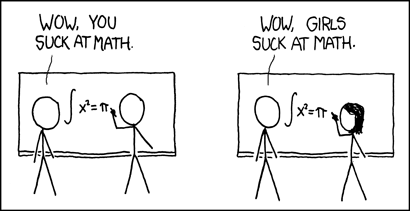
B) Recognize the biases of others: All of the statements in the paragraph above also apply here. In short never assume anything. Draw attention to these people. My personal favorite: Academic Men Explain Things to Me. This website deals with an all too common problem in STEM fields: mansplaining. Recognizing bias is only the first half of the battle. If you do encounter mansplaining, discrimination or sexism, how should you respond? 1) Cite Facts: Women earned over 50% of the bachelors degrees in chemistry last year. 2) Question their position: What makes you say that? Do you think that's really the case? In some instances, the discriminators are just repeating something another person said. When asked to stop and really confront the position, they may change their tune. If not, refer back to point #1 and cite facts. 3) Respond directly: I don't think about women that way. OR Would you have said [statement] if I was male? OR I take offense at [statement]. That was sexist. Tell people why their comments were sexist. Ask for what you want and don't want to be said. Will some people react poorly to being confronted directly? Yes, but when others are unwilling to honor requests about how we prefer to be treated, it is not our problem for speaking out, their behavior is the real problem.
2) Promote women scientistsBesides Marie Curie, how many historic women scientists can you name? What about current women in science fields? Who was the most recent woman to win a Nobel Prize for physics, chemistry or medicine? (Hint: no women in 2013). The sad fact is that we hear a great amount about the accomplishments of men. Female scientists often face discrimination or outright denial of their contributions; their work attributed to male scientists. Some notable examples from the 20th century include Rosalind Franklin (the structure of DNA) Lise Meitner (nuclear fission) and Marietta Blau (high energy particle physics). Don't forget to include the contributions of these and other women when teaching in your field. Their contributions are no less important to our understanding of nature.

Rosalind Franklin
When nominating or selecting people for awards, don't limit your field to only contributions by male scientists. Nobody wants to be the "token woman" and I'm not suggesting a quota system. But we need more awards to be distributed like the MacArthur "Genius" awards (11 of the 24 awards went to women this year), instead of like the Society for Industrial and Applied Mathematics Fellows (2 of the 33 Fellows). I need to believe that women are doing cutting-edge research that is just as interesting as their male counterparts...if only someone would allow them into the spotlight.
3) Mentor in whatever capacity you are able to do so.
As an undergraduate, I was involved in Macalester's Women in Science and Math student organization. I was able to see first-hand the impact mentor/mentee relationships had on encouraging women to remain in STEM fields. Again, this is not intended to be something that only women can do. Women shouldn't have an obligation to mentor every single female student in a department. While women might be in a position to share unique perspective about being female scientists, I speak from personal experience when I say that some of the best advice I have ever received has been from male professors. Every little bit of time helps. Whatever capacity you wish to mentor--be it taking a student for the summer or offering to read someones application essays--all it takes to be a mentor is a willingness to contribute positively (8). This relates directly back to issues of culture and feedback. Mentoring shows women that someone is encouraging them, that someone "has their back," someone feels that they are not only allowed to be here with the guys, but that they deserve to be here.
Will it be challenging to change the face of science? Yes. Is it a worthy fight? Yes! Women are in academia to stay. So rather than trying to maintain the "old boys club" isn't it about time we change the paradigm that women shouldn't be in science?Acknowledgements:
Special thanks to Naomi Y. and Louise G. for their helpful discussions and editing prowess.
References:
1) Eileen Pollack, "Why are there still so few women in science?"The New York Times. Published Online 3 Oct. 2013.
2) GMP "What Impostor Syndrome is About." Academic Jungle. Web. 25 Aug. 2013.
3) FemaleScienceProfessor "She Would Not Wish This on Her Nieces." FemaleScienceProfessor. Web. 1 Oct. 2013.
4) Moss-Racusin et al. "Scientific faculty's subtle gender biases favor male students." Proc. Natl. Acad. Sci. USA. 2012. 109(41) 16474.
5) xkcd "How It Works." http://xkcd.com/385/
6) Academic Men Explain Things to Me. Tumblr. http://mainsplained.tumblr.com/
7) Abigail Golden. "MacArthur's Genius Women: A look at the 11 female innovators recognized this year." Women in the World. Web. 1 Oct. 2013.
8) Suggestions of ways to be a mentor:
a) The NeXXT Scholars Program, which I wrote about in a previous post, is always looking for women to mentor.
b) Volunteer at a local elementary/middle school as a tutor.
c) Invite a high school or undergraduate student into your lab to do summer research.
d) Offer to read college/grad school applications. Or when the time comes, offer to read drafts of scientific manuscripts.
e) Take younger students out for ice cream or coffee, and let them ask questions about your life
f)...and many more! There are hundreds of ways to mentor someone.
b) Volunteer at a local elementary/middle school as a tutor.
c) Invite a high school or undergraduate student into your lab to do summer research.
d) Offer to read college/grad school applications. Or when the time comes, offer to read drafts of scientific manuscripts.
e) Take younger students out for ice cream or coffee, and let them ask questions about your life
f)...and many more! There are hundreds of ways to mentor someone.
Subscribe to:
Posts (Atom)