1) Dr. Kristi Curry Rogers, a biologist and geologist at Macalester College, shares her thoughts on evolution and it's role in the world today.
2) Dr. Michael Fischbach, a chemist at UCSF, talks to the NYT about the research his lab is conducting on the microbiome, as well as the results of a study his group recently published in the journal Cell.
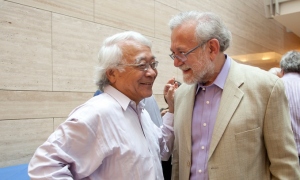
Peter Walter, PhD (right) speaks with UCSF's vice-chancellor of Research Keith Yamamoto, PhD
3) Dr. Peter Walter (above right), a biochemist at UCSF, is the recipient of the 2014 Lasker Basic Medical Research Award. Dr. Walter is sharing this award with Kazutoshi Mori, PhD, a researcher at Kyoto University.
The two scientists are being honored for their work on the Unfolded Protein Response or UPR, a cellular quality-control system which is believed to play a role in certain neurodegenerative diseases, diabetes, and cancer. This is Walter's second major award of the year--he and Mori also shared the Shaw Prize in May.
Maryam Mirzakhani, a professor of mathematics at Standford University, has been awarded the 2014 Fields Medal for her work in the fields of geometry and dynamical systems. Mirzakhani is the first women to ever win the Fields Medal (1), which is often regarded as the "Nobel Prize of mathematics."
Let me repeat that: She is the first woman EVER to win the Fields Medal.
In a statement from Mirzakhani, she says, "This is a great honor. I will be happy if it encourages young female scientists and mathematicians. I am sure there will be many more women winning this kind of award in coming years."
Congratulations Maryam Mirzakhani! Can't wait to see your future work!
1)The Fields Medal, officially known as the International Medal for Outstanding Discoveries in Mathematics, is a prize awarded every 4 years to 2-4 outstanding mathematicians under the age of 40. It is widely regarded as the highest honor a mathematician can receive and is often described as the "Nobel Prize for mathematics." The other winners for 2014 are Artur Avila, Manjul Bhargava, and Martin Hairer.
The 248th American Chemical Society (ACS) National Meeting began this past Saturday and will run through tomorrow. With the theme of "Chemistry and Global Stewardship" I could not think of a better host city than San Francisco. And because the meeting was in San Francisco, it was especially convenient for many people at my university to attend the talks. We could literally walk to the convention center from campus.
Although environmental chemistry took center stage at this meeting, there were many other excellent sessions throughout the week. With over 14,000 chemists in attendance, and many simultaneous sessions, it was frequently challenging to decide which talks to attend!
I presented a poster of some of my work in the Biological Chemistry poster session. This was my second time presenting at ACS--but my first time as a graduate student. It was exciting to talk about my work with others in the field and see where things are moving. I already have a bunch of new ideas for my project!
One of the other great things about ACS is meeting and connecting with people. It was exciting to run into (literally!) several people I knew from Macalester and be introduced to their friends and colleagues. Even introducing myself to complete strangers, we usually only needed to talk for a little bit before finding a common friend.
Old and new friends at the POLY poster session
I'm really glad I was able to attend and hear about all of the cutting-edge ways that chemistry is impacting medicine, energy and the environment. I can't wait to see what new innovations are developed from this research in the next few years. It was great #ACSsanfran and hopefully I will be there in Denver for 2015!
I'm not usually one to write about clothing or pay much attention to fashion (1). But I will make an exception to discuss San Francisco-based Betabrand. Back in January, Betabrand sent out an open casting call for a photoshoot that would highlight their spring clothing collection. The call specified the company wanted women with advanced degrees or who were working towards advanced degrees.
Over 60 women Ph.D.s and doctoral candidates responded to the call, including my own classmate, Nicole.
If you have time, visit Betabrand's website and check out the collection. Even if the clothing is not your style, I think we can all agree that these women are rockstars.
1) In fact, I tend to wear my clothing until it is literally falling apart.
2) Disclaimer: I am in no way being paid to endorse Betabrand.
I've written about UCSF's Science-Education Partnership (SEP) program previously. Since arriving at UCSF in 2011, I've been involved with two semester-long programs. My first year I was involved with the Bio&Chem Teach program, where I was partnered with a 7th grade life-science classroom. Last year I participated in the STATprogram and was placed with a 4th grade classroom.
This is my third year volunteering with SEP. After some scheduling difficulties, my classmate and I were placed in a pair of 2nd grade classrooms. Although both teachers are new to the SEP program, they brought a lot of great ideas to our first planning meeting and I am incredibly excited to be working with their students.
Our first visit to the classroom to meet the students was last week. Both classrooms had great questions for us and were excited to hear we were coming back four more times over the course of the semester. We've planned a series of lessons progressing from good/bad bacteria to human intestines, with lots of interesting experiments along the way. Hopefully by the end of the school-year I can convince some of them to stick with science!
It's always really fantastic to attend seminar and listen to the amazing research being performed at other institutions. It's even cooler when you and a classmate are able to host the speaker.
Congratulations to UCSF student Jon Ostrem (left) and UCSF fellow David Weinberg (right) for being named to Forbes 30 under 30 list in the field of Science!
Ostrem, a student in the lab of Kevan Shokat, created mutant-specific inhibitors of the oncogene K-Ras.
Weinberg, a fellow at UCSF, is studying how cells determine how much protein to produce.
I expect we will continue to hear many awesome things from these two! For the full list, follow This Link.
The Breakthrough Prize in Life Sciences Symposium is being held today at UCSF. The prize recognizes excellence in the field of Life Sciences. In its first year, the foundation awarded 11 prizes across the Life Science field including Cornelia Bargmann, David Botstein, Lewis C. Cantley, Hans Cleavers, Titia de Lange, Eric Lander, Napoleone Ferrara, Charles L. Sawyers, Bert Vogelstein, Robert A. Weinberg and Shinya Yamanaka.
Today, UCSF is honoring the recipients of the 2013 prize with an all-day symposium. They event will highlight the fields of cancer, genetics, neurobiology and stem cell research. Awardees from last year will discuss recent advances in these fields with a special focus on big ideas in human health and disease. In addition, Chancellor Susan Desmond-Hellmann will moderate a panel of the 2014 award winners.
The 2014 Breakthrough Prizes were announced last night at NASA's Ames Research Center. The laureates will join last year's winners in the selection and judging of future prize winners. The 6 winners for 2014 include:
Mahlon DeLong (Emory University)--for pioneering work in the treatment of Parkinson's Disease
Richard Lifton (Yale University)--for identifying genetic determinants that lead to hypertension
Michael Hall (University of Basel) --for the discovery of the enzyme TOR
Alexander Varshavsky (CalTech)--for the study of intracellular protein degradation
James Allison (UT Anderson Cancer Center)--for the development of immunotherapy treatments for cancer
Robert Langer (MIT)--for the development of controlled drug-release systems and biomaterials
My program and several other graduate programs in the Quantitative Biosciences Consortium (QBC) just returned from our annual retreat to Asilomar in Pacific Grove, CA. While there we heard talks from both students and professors, enjoyed humorous skits performed by the second years, and despite the chilly temperatures people braved walks on the beach during conference breaks.
I feel as though I am sometimes in a chemistry bubble, so it was great to see the research interests of students in other programs. I myself presented at one of the poster sessions. The people who stopped by my poster had lots of positive feedback and suggestions for experiments. I'm not sure how much time I will have to begin things before the holidays, but I'm excited to try some of these new directions come January!
The Bay Area Science Festival is a 10-day event organized by UCSF, UCSF's Science and Health Education Partnership, and a number of other co-sponsors. The main goal of the event is to bring science and science education to the public--though lectures, debates, workshops and a number of other activities throughout the Bay Area. This is the 3rd year the Festival is being held, and like the previous two years, I found time to volunteer at some of the interactive science booths on the "Discover Day" at AT&T Park.
Look at that awesome selfie where I shamelessly promote the Twin Cities
Last year I was involved with "Cabbage Juice Chemistry" booth. Essentially, using cabbbage juice as a handy pH indicator for various household items and asking children to predict if something was acidic or alkaline. This year, I was trained on the "Joint and Bone Models" booth. In our activity, we wanted to demonstrate the importance and complexity of our hands. To demonstrate this, we would slowly impair a child's ability to grasp and write by taping their fingers together with masking tape. The most drastic impairment, many children found, was the loss of their opposable thumb. After the exercise, many of them eagerly postulated why their thumb allowed them to do certain tasks that a pet cat or dog might not be able to accomplish.
I find that I don't think about the loss of my thumb very often. Yet after volunteering with this booth and seeing some of the models, I am becoming increasingly grateful for my opposable digit. Especially considering that many tasks I perform in the lab, such as pipetting, would be extremely difficult without my thumb. (Although, if the thatsnothowyoupipet Tumblr is any indication, I'm sure I could find a creative way to transfer liquids).
Aside from volunteering, I was also able to attend a few of the events myself. One of the last events of the festival takes place tomorrow evening. Astronaut Chris Hadfield is speaking at the NASA Ames Research Center in Mountain View, CA. For those of you who don't know Col. Hadfield, he did a cover of David Bowie's "Space Oddity" that received over 10 million views in the first few days it was posted (I've included it below for your viewing enjoyment).
Guess whose trivia team took first place and won tickets to the event?



.JPG)


.JPG)


