Monday, October 6, 2014

The 2014 Nobel Prize in Physiology or Medicine

The Nobel Assembly at Karolinska Institutet has today decided to award the 2014 Nobel Prize in Physiology or Medicine with one half to John O'Keefe, and the other half jointly to May-Britt Moser and Edvard I. Moser for their discoveries of cells that constitute a positioning system in the brain. 


John O’Keefe
Studying rats in 1971, O'Keefe discovered that certain nerve cells in the hippocampus of the brain were activated when the rat was at a particular place in the environment. At other places, different nerve cells were active. He proposed the brain has "place cells" which allow rats to build an inner map of the environment.

May Britt and Edvard I. Moser
The Moser's work focused on a nearby structure in the brain, the entohinal cortex. They found that nerve cells in this portion of the brain were activated when rats passed certain locations in a maze. Together, these locations formed a hexagonal grid, with each "grid cell" as they called them, reacting in a unique spatial pattern. The grid cells form a coordinate system that allows for spatial navigation.

Grid cells and place cells form networks with each other and also with other cells that recognize the direction of the rat's head. This complex network is an inner GPS for the brain. However it's not just rats that have this positioning system. Humans, too, appear to have similar cells as those found in the rat brains.

Listen to their reactions:

May-Brit Moser:


John O'Keefe:


Edvard I. Moser:


Relevant Publications:
1. O'Keefe and Dostrovsky. "The hippocampus as a spatial map. Preliminary evidence from unit activity in the freely-moving rat brain." Brain Research, 1971, 34, 171.

2. O'Keefe, J. "Place units in the hippocampus of the freely moving rat." Experimental Neurology, 1976, 34, 78.

3. Fyhn et al. "Spatial representation in the entohinal cortex." Science, 2004, 305, 1258.

4. Hafting, et al. "Microstructure of spatial map in the entohinal cortex." Nature, 2005, 436, 801.

5. Sargolini et al. "Conjunctive representation of position, direction, and velocity in the entohinal cortex." Science, 2008, 312, 758.

Sunday, October 5, 2014

Nobel Week


The Nobel Prize is a set of awards in the fields of literature, medicine, physics, chemistry, economics and peace. It is awarded annually in recognition of cultural and/or scientific advances and is widely considered the most prestigious award in the above fields. 

For scientists, the Nobel Prize is like winning a gold medal at the Olympics or "Best Actor" at the Oscars. It's a really, really big deal. 

So in honor of Nobel Week, I will be highlighting all of the 2014 prizes. The first announcement, scheduled for Oct 6th, is in the field of Physiology or Medicine. Predictions anyone? 


Read more about the Nobel Foundation here

Sunday, September 21, 2014

In the News: A link roundup


1) Dr. Kristi Curry Rogers, a biologist and geologist at Macalester College, shares her thoughts on evolution and it's role in the world today. 


2) Dr. Michael Fischbach, a chemist at UCSF, talks to the NYT about the research his lab is conducting on the microbiome, as well as the results of a study his group recently published in the journal Cell

Link to the NY Times article
Link to the study published in the journal Cell


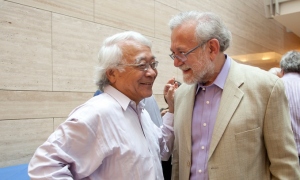
Peter Walter, PhD (right) speaks with UCSF's vice-chancellor of Research Keith Yamamoto, PhD

3) Dr. Peter Walter (above right), a biochemist at UCSF, is the recipient of the 2014 Lasker Basic Medical Research Award. Dr. Walter is sharing this award with Kazutoshi Mori, PhD, a researcher at Kyoto University. 

The two scientists are being honored for their work on the Unfolded Protein Response or UPR, a cellular quality-control system which is believed to play a role in certain neurodegenerative diseases, diabetes, and cancer. This is Walter's second major award of the year--he and Mori also shared the Shaw Prize in May. 


Thursday, August 14, 2014

Maryam Mirzakhani: First woman to win Fields Medal


Maryam Mirzakhani, a professor of mathematics at Standford University, has been awarded the 2014 Fields Medal for her work in the fields of geometry and dynamical systems. Mirzakhani is the first women to ever win the Fields Medal (1), which is often regarded as the "Nobel Prize of mathematics."

Let me repeat that: She is the first woman EVER to win the Fields Medal. 

In a statement from Mirzakhani, she says, "This is a great honor. I will be happy if it encourages young female scientists and mathematicians. I am sure there will be many more women winning this kind of award in coming years."

Congratulations Maryam Mirzakhani! Can't wait to see your future work! 


1) The Fields Medal, officially known as the International Medal for Outstanding Discoveries in Mathematics, is a prize awarded every 4 years to 2-4 outstanding mathematicians under the age of 40. It is widely regarded as the highest honor a mathematician can receive and is often described as the "Nobel Prize for mathematics." The other winners for 2014 are Artur Avila, Manjul Bhargava, and Martin Hairer. 

Wednesday, August 13, 2014

LIVE from the ACS Meeting


The 248th American Chemical Society (ACS) National Meeting began this past Saturday and will run through tomorrow. With the theme of "Chemistry and Global Stewardship" I could not think of a better host city than San Francisco. And because the meeting was in San Francisco, it was especially convenient for many people at my university to attend the talks. We could literally walk to the convention center from campus. 


Although environmental chemistry took center stage at this meeting, there were many other excellent sessions throughout the week. With over 14,000 chemists in attendance, and many simultaneous sessions, it was frequently challenging to decide which talks to attend! 

I presented a poster of some of my work in the Biological Chemistry poster session. This was my second time presenting at ACS--but my first time as a graduate student. It was exciting to talk about my work with others in the field and see where things are moving. I already have a bunch of new ideas for my project!

One of the other great things about ACS is meeting and connecting with people. It was exciting to run into (literally!) several people I knew from Macalester and be introduced to their friends and colleagues. Even introducing myself to complete strangers, we usually only needed to talk for a little bit before finding a common friend. 

Old and new friends at the POLY poster session

I'm really glad I was able to attend and hear about all of the cutting-edge ways that chemistry is impacting medicine, energy and the environment. I can't wait to see what new innovations are developed from this research in the next few years. It was great #ACSsanfran and hopefully I will be there in Denver for 2015!

Thursday, May 22, 2014

"Forgive me, scientists, for I have sinned"

Adam Ruben, PhD, author of the book Surviving Your Stupid, Stupid Decision to Go to Grad School has a new post on the Science/AAAS magazine. Follow the link below to read the full post.

http://sciencecareers.sciencemag.org/career_magazine/previous_issues/articles/2014_05_20/caredit.a1400126