Where are the women at the International Math Olympiad competition? Fivethirtyeight looks at the distribution of women on these teams.
http://fivethirtyeight.com/datalab/girls-are-rare-at-the-international-math-olympiad/
Thursday, July 23, 2015

Monday, January 26, 2015
Cheers
Cheers...
...to the women in my program for discussing the problem of recruiting more women.
...for our meeting generating several concrete, actionable items.
...for the serious response we received from the administration when voicing our concerns.
...for the actions the administration will put in place this year during recruitment.
...for some of the guys in my program who recognized their past behavior may have been taken the wrong way.
...for that same group asking me for ways they could change and behaviors to watch out for from other guys.
...to the (male) friend who went to a science conference as a +1...and realized how messed up it was that people assumed he was the scientist and his girlfriend (the actual scientist) was along for the ride.
...for the guys who want to hear my experiences of being a women in academia...so they know how to challenge their unconscious biases.
In the grand scheme of things, this is small. But changes can't always come from the top. More often, they must start with the people on the bottom.
...to the women in my program for discussing the problem of recruiting more women.
...for our meeting generating several concrete, actionable items.
...for the serious response we received from the administration when voicing our concerns.
...for the actions the administration will put in place this year during recruitment.
...for some of the guys in my program who recognized their past behavior may have been taken the wrong way.
...for that same group asking me for ways they could change and behaviors to watch out for from other guys.
...to the (male) friend who went to a science conference as a +1...and realized how messed up it was that people assumed he was the scientist and his girlfriend (the actual scientist) was along for the ride.
...for the guys who want to hear my experiences of being a women in academia...so they know how to challenge their unconscious biases.
In the grand scheme of things, this is small. But changes can't always come from the top. More often, they must start with the people on the bottom.
Friday, October 31, 2014
Friday Funnies: Halloween Costume Edition
Like all lady Ph.D. students, I frequently ask myself: "How could I be sexier?" Thank goodness for this Halloween costume. Stylish AND safety-conscious with the polyester robe and the 5" heels. I'm only sad that it doesn't come in pink or purple to match my BIC lady pens </sarcasm>.

Seriously though, read the comments on Amazon. They are top-notch.
Friday, October 17, 2014
MacTalks - Chad Topaz
Listen to one of my favorite professors from Macalester talk about community and how the idea of community informs his research on biological swarms, why community is essential for scientific progress, and how developing community is crucial for teaching and learning.
Wednesday, October 8, 2014
The 2014 Nobel Prize in Chemistry
The Royal Swedish Academy of Sciences has decided to award the Nobel Prize in Chemistry for 2014 to Eric Betzig, Stefan W. Hell and William E. Moerner for the development of super-resolved fluorescence microscopy."


Eric Betzig Stefan Hell William Moerner
Optical microscopy was limited for a long time by the presumed limitation that it would never get resolution better than half the wavelength of light. In what is now known as 'nanoscopy' this year's Nobel Laureates circumvented this limitation, with the help of fluorescent molecules. Their pioneering work in the field of microscopy allows us to see how molecules create synapses between nerve cells, track proteins involved in Alzheimer's and Parkinson's disease, and follow individual proteins as a fertilized egg divides into an embryo.
Watch the announcement here:
Tuesday, October 7, 2014
The 2014 Nobel Prize in Physics
The Royal Swedish Academy of Sciences has decided to award the Nobel Prize in Physics for 2014 to Isamu Akasaki, Hiroshi Amano, and Shuji Nakamura, for the invention of efficient blue light-emitting diodes which has enabled bright and energy-saving white light sources."
This year's Nobel Laureates invented a new energy efficient light source--the blue light-emitting diode (LED). With the invention of blue LEDs, white light can be created in new ways that is both longer lasting and more efficient than older alternative light sources.
Listen to Shuji Nakamura's reaction:
Watch the announcement of the prize and learn more about LEDs here!
Monday, October 6, 2014
The 2014 Nobel Prize in Physiology or Medicine
The Nobel Assembly at Karolinska Institutet has today decided to award the 2014 Nobel Prize in Physiology or Medicine with one half to John O'Keefe, and the other half jointly to May-Britt Moser and Edvard I. Moser for their discoveries of cells that constitute a positioning system in the brain.


John O’Keefe
Studying rats in 1971, O'Keefe discovered that certain nerve cells in the hippocampus of the brain were activated when the rat was at a particular place in the environment. At other places, different nerve cells were active. He proposed the brain has "place cells" which allow rats to build an inner map of the environment.
May Britt and Edvard I. Moser
The Moser's work focused on a nearby structure in the brain, the entohinal cortex. They found that nerve cells in this portion of the brain were activated when rats passed certain locations in a maze. Together, these locations formed a hexagonal grid, with each "grid cell" as they called them, reacting in a unique spatial pattern. The grid cells form a coordinate system that allows for spatial navigation.
Grid cells and place cells form networks with each other and also with other cells that recognize the direction of the rat's head. This complex network is an inner GPS for the brain. However it's not just rats that have this positioning system. Humans, too, appear to have similar cells as those found in the rat brains.
Listen to their reactions:
May-Brit Moser:
John O'Keefe:
Edvard I. Moser:
Relevant Publications:
1. O'Keefe and Dostrovsky. "The hippocampus as a spatial map. Preliminary evidence from unit activity in the freely-moving rat brain." Brain Research, 1971, 34, 171.
2. O'Keefe, J. "Place units in the hippocampus of the freely moving rat." Experimental Neurology, 1976, 34, 78.
3. Fyhn et al. "Spatial representation in the entohinal cortex." Science, 2004, 305, 1258.
4. Hafting, et al. "Microstructure of spatial map in the entohinal cortex." Nature, 2005, 436, 801.
5. Sargolini et al. "Conjunctive representation of position, direction, and velocity in the entohinal cortex." Science, 2008, 312, 758.
Sunday, October 5, 2014
Nobel Week

The Nobel Prize is a set of awards in the fields of literature, medicine, physics, chemistry, economics and peace. It is awarded annually in recognition of cultural and/or scientific advances and is widely considered the most prestigious award in the above fields.
For scientists, the Nobel Prize is like winning a gold medal at the Olympics or "Best Actor" at the Oscars. It's a really, really big deal.
So in honor of Nobel Week, I will be highlighting all of the 2014 prizes. The first announcement, scheduled for Oct 6th, is in the field of Physiology or Medicine. Predictions anyone?
Read more about the Nobel Foundation here
Sunday, September 21, 2014
In the News: A link roundup
1) Dr. Kristi Curry Rogers, a biologist and geologist at Macalester College, shares her thoughts on evolution and it's role in the world today.

2) Dr. Michael Fischbach, a chemist at UCSF, talks to the NYT about the research his lab is conducting on the microbiome, as well as the results of a study his group recently published in the journal Cell.
Link to the NY Times article
Link to the study published in the journal Cell
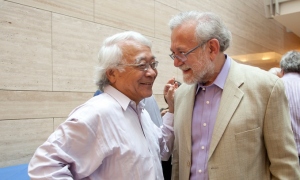
Peter Walter, PhD (right) speaks with UCSF's vice-chancellor of Research Keith Yamamoto, PhD
3) Dr. Peter Walter (above right), a biochemist at UCSF, is the recipient of the 2014 Lasker Basic Medical Research Award. Dr. Walter is sharing this award with Kazutoshi Mori, PhD, a researcher at Kyoto University.
The two scientists are being honored for their work on the Unfolded Protein Response or UPR, a cellular quality-control system which is believed to play a role in certain neurodegenerative diseases, diabetes, and cancer. This is Walter's second major award of the year--he and Mori also shared the Shaw Prize in May.
Thursday, August 14, 2014
Maryam Mirzakhani: First woman to win Fields Medal

Maryam Mirzakhani, a professor of mathematics at Standford University, has been awarded the 2014 Fields Medal for her work in the fields of geometry and dynamical systems. Mirzakhani is the first women to ever win the Fields Medal (1), which is often regarded as the "Nobel Prize of mathematics."
Let me repeat that: She is the first woman EVER to win the Fields Medal.
In a statement from Mirzakhani, she says, "This is a great honor. I will be happy if it encourages young female scientists and mathematicians. I am sure there will be many more women winning this kind of award in coming years."
Congratulations Maryam Mirzakhani! Can't wait to see your future work!
1) The Fields Medal, officially known as the International Medal for Outstanding Discoveries in Mathematics, is a prize awarded every 4 years to 2-4 outstanding mathematicians under the age of 40. It is widely regarded as the highest honor a mathematician can receive and is often described as the "Nobel Prize for mathematics." The other winners for 2014 are Artur Avila, Manjul Bhargava, and Martin Hairer.
Wednesday, August 13, 2014
LIVE from the ACS Meeting
.JPG)
The 248th American Chemical Society (ACS) National Meeting began this past Saturday and will run through tomorrow. With the theme of "Chemistry and Global Stewardship" I could not think of a better host city than San Francisco. And because the meeting was in San Francisco, it was especially convenient for many people at my university to attend the talks. We could literally walk to the convention center from campus.
Although environmental chemistry took center stage at this meeting, there were many other excellent sessions throughout the week. With over 14,000 chemists in attendance, and many simultaneous sessions, it was frequently challenging to decide which talks to attend!
I presented a poster of some of my work in the Biological Chemistry poster session. This was my second time presenting at ACS--but my first time as a graduate student. It was exciting to talk about my work with others in the field and see where things are moving. I already have a bunch of new ideas for my project!
One of the other great things about ACS is meeting and connecting with people. It was exciting to run into (literally!) several people I knew from Macalester and be introduced to their friends and colleagues. Even introducing myself to complete strangers, we usually only needed to talk for a little bit before finding a common friend.

Old and new friends at the POLY poster session
I'm really glad I was able to attend and hear about all of the cutting-edge ways that chemistry is impacting medicine, energy and the environment. I can't wait to see what new innovations are developed from this research in the next few years. It was great #ACSsanfran and hopefully I will be there in Denver for 2015!
Friday, May 30, 2014

Thursday, May 22, 2014
"Forgive me, scientists, for I have sinned"
Adam Ruben, PhD, author of the book Surviving Your Stupid, Stupid Decision to Go to Grad School has a new post on the Science/AAAS magazine. Follow the link below to read the full post.
http://sciencecareers.sciencemag.org/career_magazine/previous_issues/articles/2014_05_20/caredit.a1400126
http://sciencecareers.sciencemag.org/career_magazine/previous_issues/articles/2014_05_20/caredit.a1400126
Sunday, May 18, 2014
Scientist Profile: Sophie Dumont

The Scientist does a profile on UCSF's own Sophie Dumont. Check out the link below!
http://www.the-scientist.com/?articles.view/articleNo/39778/title/Sophie-Dumont--Forces-at-Play/
Friday, April 25, 2014
Friday Fun: Elementary School Edition

"What do owls eat?"
This past Thursday was my last SEP science lesson for this school year. Building from our digestion theme from the last visit, this lesson was all about owl pellets. Owls frequently swallow their prey whole. However, they cannot digest the prey's fur or bones, so they regurgitate the material.
Scientists often collect the owl pellets and study their contents to determine seasonal eating habits and estimate populations of various rodent species. Owl pellets are also a common first dissection for elementary school children, as the bones are well-preserved, it feels like a treasure hunt for the kids, and they can learn fantastic scientific method skills like asking questions (What do owls eat?), testing their hypotheses (performing the dissection), analyzing the results (What did we find in the owl pellets? How many of each rodent are there?) and drawing conclusions.
The children were incredibly excited to do the owl pellet dissection--constantly calling one of us over to show what they had found or to ponder what a particular bone was used for. It was a whirlwind end to the semester, but everyone (including the teachers) seemed to really enjoy it.
After both classes were finished, the teachers presented us each with a bouquet of flowers

Flowers!
and a packet of really cute thank-you letters.
.JPG)
This student drew a picture of the preserved small intestine we brought.
Fun and cute excerpts from our thank-you letters:
1) Dear Mr. Louise (sic) and Ms. Christina...
2) I liked to touch the guts but the guts stinked (sic).
3) It was cool when you put germs on our hands.
4) I remember when you had five senses.
5) Thank you for visiting our class room and teaching us cool science stuff? (sic)
This was my third year in a row volunteering with SEP. I also think this was my favorite year. The teachers we partnered with were absolutely amazing! The students were always so well-prepared before we came in and always asked insightful questions. Their preparation and the students genuine enthusiasm made it really easy to get them thinking aloud and participating in the experiments.
As Henri Poincaré, the French mathematician wrote:
"The scientist does not study nature because it is useful; he studies it because
he delights in it, and he delights in it because it is beautiful."
I hope Louise and I had a positive influence on the students and that some of them choose to stick with science. It's a field with many ups and downs, but it's also so full of wonder and awe.
Tuesday, April 22, 2014
In Honor of Boston...
In honor of the Boston, I present the Chemistry of Marathon Running:
http://www.acs.org/content/dam/acsorg/education/resources/highschool/chemmatters/chemmatters-oct2008-marathon.pdf
More posts to follow next week!
http://www.acs.org/content/dam/acsorg/education/resources/highschool/chemmatters/chemmatters-oct2008-marathon.pdf
More posts to follow next week!
Sunday, April 6, 2014
microFutures
Each week, Nature publishes a science fiction story in their "Futures" column. At the beginning of the year, they challenged readers to write a science fiction story in no more than 200 characters. Here is the winning entry, as well as some of my favorite submissions.
WINNER:
I pass your empty chair every day. Across the room sits the computer, your voice, your face locked inside. I ache to bring you to life, but fear keeps me in my chair. What if you say no?
--Catherine Rastovsk
Favorites:
off that switch, Professor! Your time machine can't travel back in time past the moment of its own creation and instead will trap the Universe in an endlessly recursive time-like loop! Take your hands
--Judith Reeves-Stevens
We gather, receiving the voice of a deserted explorer. "I have found the lunar colony," she says across the void. "Their logs simply state, 'We die alone'." Eyes downcast, we hear the broadcast end.
--Alasdair MacLeod
As robots perform the laboratory work, it is cheaper just to electronically stimulate the areas of the student's brain associated with frustration and failure, and then, after 3 years, call them doctor.
--Gavin Garland
To see the full list, visit: http://www.nature.com/nature/journal/v508/n7494/full/508144a.html
WINNER:
I pass your empty chair every day. Across the room sits the computer, your voice, your face locked inside. I ache to bring you to life, but fear keeps me in my chair. What if you say no?
--Catherine Rastovsk
Favorites:
off that switch, Professor! Your time machine can't travel back in time past the moment of its own creation and instead will trap the Universe in an endlessly recursive time-like loop! Take your hands
--Judith Reeves-Stevens
We gather, receiving the voice of a deserted explorer. "I have found the lunar colony," she says across the void. "Their logs simply state, 'We die alone'." Eyes downcast, we hear the broadcast end.
--Alasdair MacLeod
As robots perform the laboratory work, it is cheaper just to electronically stimulate the areas of the student's brain associated with frustration and failure, and then, after 3 years, call them doctor.
--Gavin Garland
To see the full list, visit: http://www.nature.com/nature/journal/v508/n7494/full/508144a.html
Monday, March 31, 2014
Dr. Cynthia Wolberger
Dr. Cynthia Wolberger of Johns Hopkins is giving a seminar on Tuesday (April 1st) as part of the Mission Bay Lecture Series here at UCSF. She will present recent work from her lab on how ubiquitination affects transcription. Typically, the speaker also gives an informal lunch talk with students the day before the main event. This one sounds interesting:
.JPG)
Friday, March 28, 2014
Friday Funnies: Venn Diagram Edition
1) Nerds vs. Geeks (credit--Yamamoto Lab, UCSF)
.JPG)
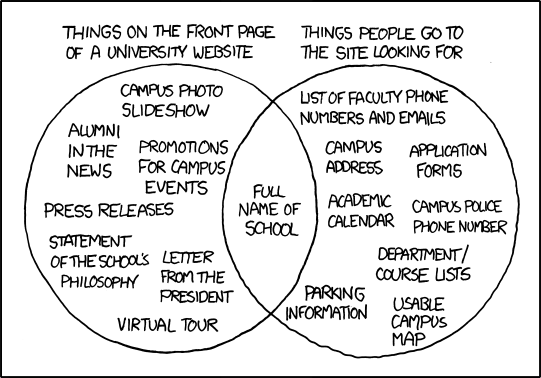
2) University Websites (credit-xkcd)


2) University Websites (credit-xkcd)
3) Mathematics meets Rap (credit-SMBC)

4) Explaining my life (credit-f*** no grad school)

Happy Friday!
Tuesday, March 18, 2014
Cosmos has arrived!

I first wrote about the re-make of Cosmos in this blog post. The first episode aired last Sunday evening. You can watch the first two episodes online, and I've also included the links below.
In this first episode, Tyson introduces a few famous scientists from history and highlights how their ideas shaped the current model of the universe. What follows next is a whirlwind tour of the history of the universe--from the Big Bang all the way through to the evolution of man.
Episode #2: Some of the Things That Molecules Do
In this episode, we leave the world of the stars and go to the molecular level--the genetic code. Tyson explains the difference between artificial and natural selection. Yet he cautions that even when evolution comes up with a specialized adaptation, there is no accounting for catastrophic events and the extinction of a species. The program concludes with speculation about life on other planets.

This show is not meant to be a hard science program. The biology presented in the second episode is something that every high school student should know. Instead, I'm hoping this program will begin a dialogue.
In this reboot of the Cosmos series, the producers' goals are to encourage science literacy. Executive producer Seth MacFarlane had this to say about the show:
"I think that there is a hunger for science and known about science
and understanding of science that hasn't really been fed in the past
two decades [...] There's been a real vacuum when it comes to science
education. The nice thing about this show is that I think that it does what the
original 'Cosmos' did and presents it in such a flashy, entertaining way that, as
Carl Sagan put it in 1980, even people who have no interest in science
will watch just because it's a spectacle."
I agree with MacFarlane's analysis--there has been a real lack of popular shows about the natural world. I'm not sure that the science presented on Cosmos needs to be flashy and entertaining. Yet I can appreciate the stories and animations as a way to introduce fundamental scientific discoveries and help foster an interest in those who wish to learn more. I hope that people who are interested in science will now have a starting point for further reading and researching topics of interest and that the show will inspire the public to support scientific research and discovery.
Subscribe to:
Posts (Atom)